Fasting Vocabulary in the Bible¶
Hebrew OT · Aramaic OT · LXX · Greek NT¶
Generated 2026-05-15
Build scripts: scripts/both/word_studies/fasting/build_fasting_charts.py · scripts/both/word_studies/fasting/build_fasting_report.py
Summary¶
| Lemma | Language / Corpus | Strong's | POS | Count |
|---|---|---|---|---|
| צוּם (tsum) | Hebrew OT | H6684 | Verb | 21 |
| צוֹם (tsom) | Hebrew OT | H6685 | Noun | 26 |
| טְוָת (tevat) | Aramaic OT | H2908 | Adverb | 1 |
| νηστεύω (nēsteuō) | LXX | G3522 | Verb | 23 |
| νηστεία (nēsteia) | LXX | G3521 | Noun | 27 |
| ἀσιτέω (asitoō) | LXX (incl. Deuterocanon) | — | Verb | 2 |
| ἀσιτί (asiti) | LXX | — | Adverb | 1 |
| νηστεύω (nēsteuō) | Greek NT | G3522 | Verb | 21 |
| νηστεία (nēsteia) | Greek NT | G3521 | Noun | 8 |
| νῆστις (nēstis) | Greek NT | G3523 | Adjective | 2 |
| ἀσιτία (asitia) | Greek NT | G0776 | Noun | 1 |
| ἄσιτος (asitos) | Greek NT | G0777 | Adjective | 1 |
Total Hebrew OT: 47 | Aramaic OT: 1 | LXX core: 50 + LXX ἀσιτ- family: 3 | Greek NT: 33
Cross-Corpus Overview¶

The Hebrew OT has 47 total fasting references (21 verbal, 26 nominal). The LXX translates these with near 1:1 correspondence using νηστεύω (verb) and νηστεία (noun). The Greek NT employs a broader vocabulary, with the core νηστεύω/νηστεία pair supplemented by three rarer terms. The single Aramaic occurrence uses a distinct adverb (טְוָת) without a Hebrew cognate in the same text.
1. Hebrew OT¶
1.1 The Core Pair¶
Biblical Hebrew uses a single root צ-ו-מ (tsade-waw-mem) for all fasting language:
- צוּם (H6684) — the verb "to fast, abstain from food" — 21× (Qal only)
- צוֹם (H6685) — the noun "a fast, fasting" — 26×
There are no other Hebrew roots for voluntary fasting. The pair covers the full semantic range: the act of fasting (verb) and the period or practice of fasting as an institution (noun).
1.2 Distribution by Book¶
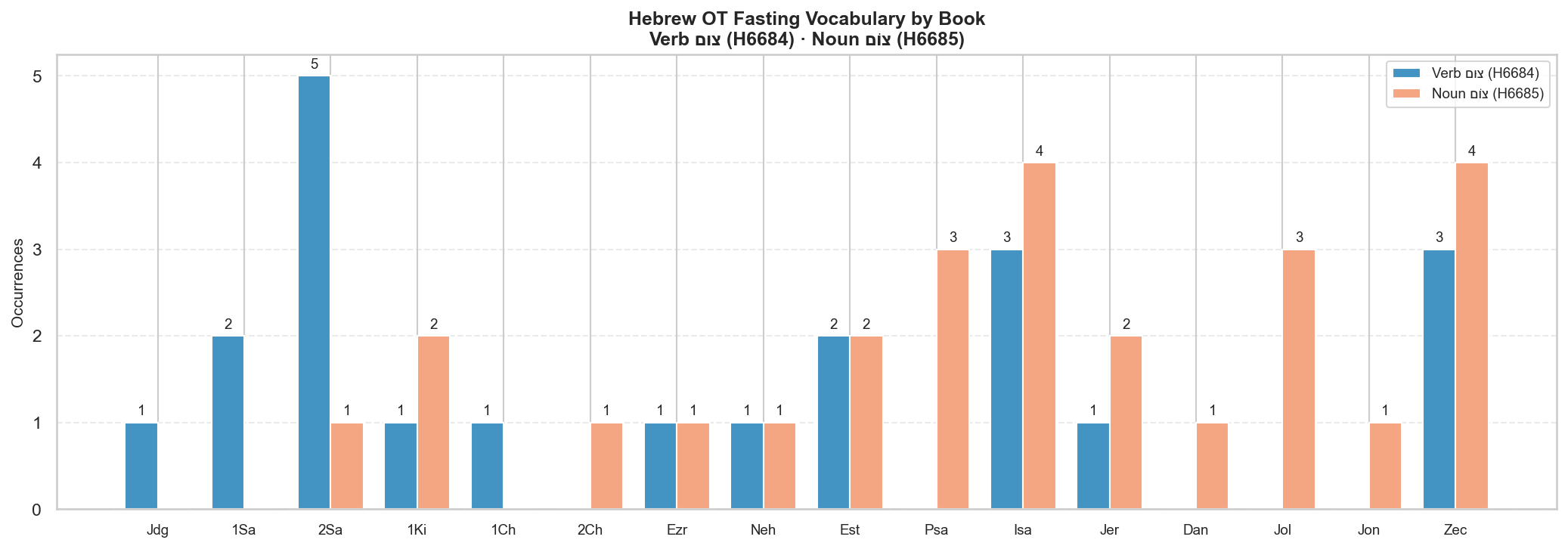
| Book | Verb צוּם | Noun צוֹם | Total |
|---|---|---|---|
| Judges | 1 | — | 1 |
| 1 Samuel | 2 | — | 2 |
| 2 Samuel | 5 | 1 | 6 |
| 1 Kings | 1 | 2 | 3 |
| 1 Chronicles | 1 | — | 1 |
| 2 Chronicles | — | 1 | 1 |
| Ezra | 1 | 1 | 2 |
| Nehemiah | 1 | 1 | 2 |
| Esther | 2 | 2 | 4 |
| Psalms | — | 3 | 3 |
| Isaiah | 3 | 4 | 7 |
| Jeremiah | 1 | 2 | 3 |
| Daniel | — | 1 | 1 |
| Joel | — | 3 | 3 |
| Jonah | — | 1 | 1 |
| Zechariah | 3 | 4 | 7 |
| Total | 21 | 26 | 47 |
Concentration points: - 2 Samuel (6×): David's fasts — for the dying child (12:16–23), for the death of Saul (1:12), for Abner (3:35), at Mizpah (1 Sam 7:6), and the battle at Gibeah (Jdg 20:26 paralleled in 2 Sam). - Isaiah 58 (7×): The famous "true fast" discourse — the most concentrated fasting passage in the OT. Both the verb (4×) and noun (3×) appear in vv. 3–6. - Zechariah 7–8 (7×): The question about fasting in the fourth, fifth, seventh, and tenth months — an institutional discussion of commemorative fasts established during the exile. - Joel (3×): The communal fast proclaimed as part of a national lament/repentance response to the locust plague.
1.3 Conjugation Distribution of צוּם (H6684)¶
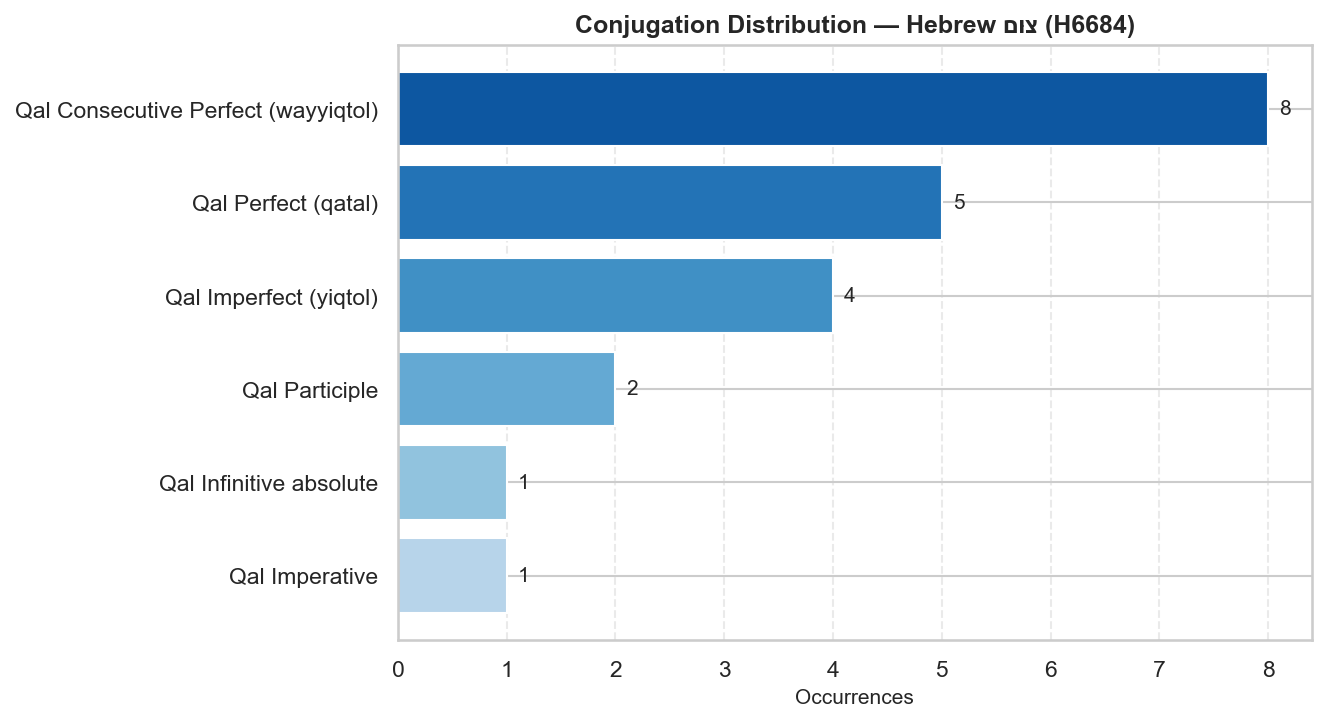
| Stem | Conjugation | Count | % |
|---|---|---|---|
| Qal | Consecutive Perfect (wayyiqtol) | 7 | 33.3% |
| Qal | Imperfect (yiqtol) | 4 | 19.0% |
| Qal | Perfect (qatal) | 4 | 19.0% |
| Qal | Participle | 2 | 9.5% |
| — | Pronominal suffix | 2 | 9.5% |
| Qal | Imperative | 1 | 4.8% |
| Qal | Infinitive absolute | 1 | 4.8% |
All 21 occurrences are Qal — the simple active stem. The dominance of the wayyiqtol (33%) reflects narrative use: fasting as a sequenced event in historical prose. The high percentage of yiqtol + imperative forms (23%) reflects exhortation and prophetic commands to fast (Isaiah 58, Joel, Zechariah, Esther 4:16).
1.4 Key Passage Notes¶
| Passage | Notes |
|---|---|
| Jdg 20:26 | First OT occurrence — Israel fasts before the LORD after military defeat |
| 2 Sam 12:16–23 | David fasts while the child is ill, stops after death — reversal of normal mourning order |
| 1 Kgs 21:9,12,27 | Jezebel proclaims a false fast (noun ×2); Ahab genuinely fasts (verb) after condemnation |
| Ezr 8:21–23 | Ezra proclaims a fast before the return journey — refuses military escort, trusting God |
| Neh 1:4 | Nehemiah fasts upon hearing of Jerusalem's ruin |
| Est 4:3,16; 9:31 | Esther and Mordecai's fast — the only OT fast explicitly linked to intercessory action on behalf of the people without a named prophet |
| Psa 35:13; 69:10; 109:24 | Fasting as personal lament and devotional practice |
| Isa 58:3–7 | The prophetic critique of empty fasting — contrasts ritual abstinence with justice, release of oppressed, feeding the hungry |
| Joel 1:14; 2:12,15 | Corporate fasts as lamentation rites; Joel 2:12 is the most explicit OT call to heart-oriented fasting |
| Jon 3:5 | The Ninevite fast — the only Gentile communal fast in the OT |
| Zec 7:5; 8:19 | Four commemorative fasts of the exile transformed into occasions of joy |
2. Aramaic OT¶
2.1 טְוָת (H2908) — Dan 6:18¶
The Aramaic portions of the OT (Daniel 2–7, Ezra 4–7) use their own vocabulary. Fasting appears only once in Aramaic:
| Reference | Word | Gloss | Context |
|---|---|---|---|
| Dan 6:18 | טְוָ֔ת (tevat) | "fasting" (adv.) | Darius passes the night fasting while Daniel is in the lion's den |
טְוָת (H2908) is an Aramaic adverb, not a cognate of Hebrew צוּם. It functions adverbially: "he passed the night fasting." This is the only fasting term unique to Biblical Aramaic. The LXX translator of Daniel LXX does not use νηστεύω or νηστεία here — the word appears to be rendered contextually.
Note: Dan 9:3 (Hebrew צוֹם) is in the Hebrew portion of Daniel, not the Aramaic section.
3. LXX (Septuagint)¶
3.1 Translation Equivalents¶
The LXX translates the Hebrew fasting vocabulary with striking consistency:
| Hebrew | LXX Greek | Alignment |
|---|---|---|
| צוּם verb (H6684) | νηστεύω (G3522) | 25 of top aligned tokens |
| צוֹם noun (H6685) | νηστεία (G3521) | 30 of top aligned tokens |
This is a near-perfect lexical correspondence — the translators rendered the Hebrew root pair with a Greek root pair (νῆστ-) that exactly parallels the Hebrew verb/noun distinction.
3.2 LXX Distribution by Book¶
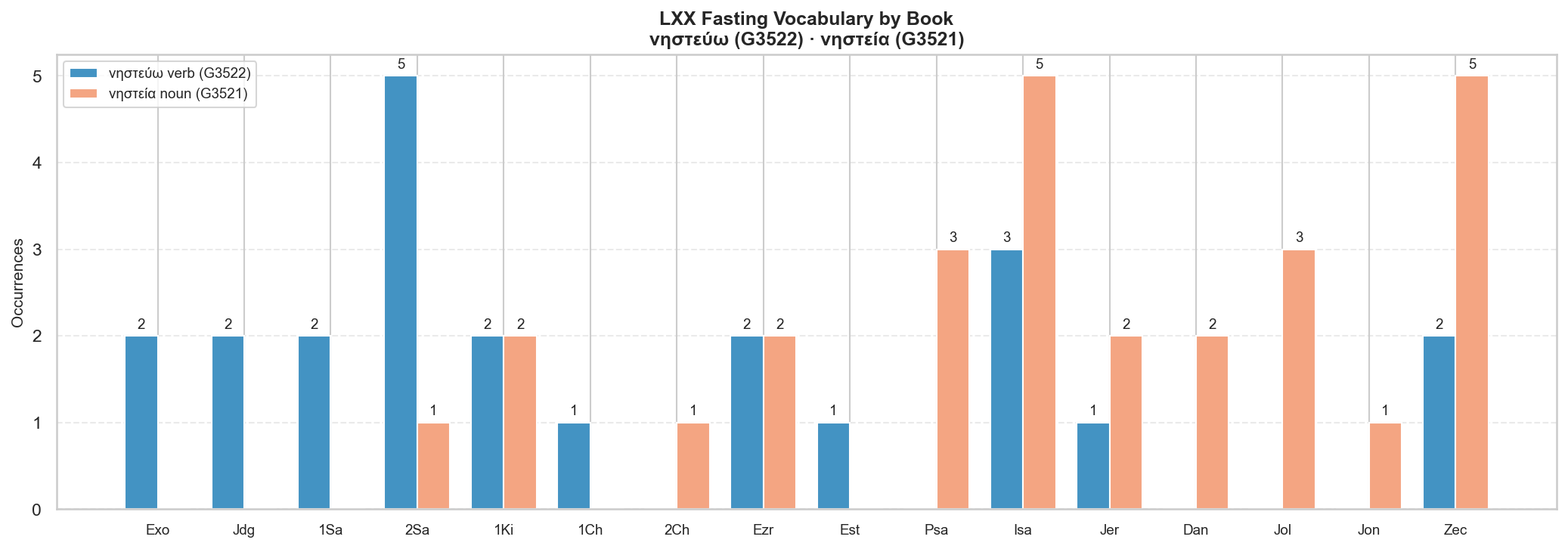
| Book | νηστεύω (verb) | νηστεία (noun) | Total |
|---|---|---|---|
| Exodus | 2 | — | 2 |
| Judges | 2 | — | 2 |
| 1 Samuel | 2 | — | 2 |
| 2 Samuel | 5 | 1 | 6 |
| 1 Kings | 2 | 2 | 4 |
| 1 Chronicles | 1 | — | 1 |
| 2 Chronicles | — | 1 | 1 |
| Ezra | 2 | 2 | 4 |
| Esther | 1 | — | 1 |
| Psalms | — | 3 | 3 |
| Isaiah | 3 | 5 | 8 |
| Jeremiah | 1 | 2 | 3 |
| Daniel | — | 2 | 2 |
| Joel | — | 3 | 3 |
| Jonah | — | 1 | 1 |
| Zechariah | 2 | 5 | 7 |
| Total | 23 | 27 | 50 |
The LXX totals (50) slightly exceed the Hebrew totals (47), likely due to: (1) LXX pluses in certain books, and (2) the LXX Exodus occurrences (2×) rendering passages not paralleled in the MT count (possibly Exod 34:28 or related narrative). The distribution otherwise mirrors the Hebrew closely.
3.3 Exodus Note¶
The two LXX Exodus occurrences of νηστεύω are notable — they likely correspond to Exod 34:28 (Moses on Sinai "neither ate bread nor drank water for 40 days") which uses לֹא אָכַל in Hebrew but which the LXX may render with fasting vocabulary. This shows the LXX interpreting implied fasting with explicit fasting language.
3.4 The ἀσιτ- Family in the LXX (3 occurrences)¶
Alongside the core νηστεύω/νηστεία pair, the LXX uses a second, smaller word family built on the α-privative + σῖτος (food) root — "without food":
| Reference | Word | Lemma | POS | Context |
|---|---|---|---|---|
| Est 4:16 | ἀσιτήσομεν | ἀσιτέω | Verb | Esther's command: "fast for me … do not eat or drink" — LXX renders צוּם with ἀσιτέω here rather than νηστεύω |
| 1 Mac 3:17 | ἀσιτοῦντες | ἀσιτέω | Verb | Judas Maccabaeus's army — "fasting" before battle against Nicanor (Deuterocanon) |
| Job 24:6 | ἀσιτὶ | ἀσιτί | Adverb | "The poor glean … [and the wicked harvest] without food" — describes involuntary food deprivation |
Key observations: - The LXX translators had two options when rendering Hebrew fasting vocabulary: the standard νηστεύω/νηστεία pair and the ἀσιτ- family. Est 4:16 is the only case where they chose ἀσιτέω over νηστεύω for a deliberate religious fast. - ἀσιτέω is absent from the NT entirely — Paul opts for the noun ἀσιτία and adjective ἄσιτος instead (Acts 27:21, 27:33), perhaps because these felt more natural in his nautical context. - The LXX never uses ἀσιτία (noun) or ἄσιτος (adjective) — those specific forms are NT innovations, though the underlying root is attested in the LXX. - Job 24:6 uses ἀσιτί for involuntary deprivation among the poor — exactly paralleling Paul's use for the storm-stranded crew in Acts 27, suggesting a consistent register distinction: the ἀσιτ- family gravitates toward unwanted or circumstantial lack of food, while νηστεύω marks intentional religious practice.
4. Greek New Testament¶
4.1 Full Vocabulary¶
The NT expands the fasting vocabulary slightly, using five lemmas:
| Lemma | Translit | Strong's | POS | Count | Key Passages |
|---|---|---|---|---|---|
| νηστεύω | nēsteuō | G3522 | Verb | 21 | Mat 4:2; 6:16–18; 9:14–15; Mrk 2:18–20; Luk 5:33–35; 18:12; Act 13:2–3 |
| νηστεία | nēsteia | G3521 | Noun | 8 | Mat 17:21*; Mrk 9:29*; Luk 2:37; Act 14:23; 27:9; 1Co 7:5*; 2Co 6:5; 11:27 |
| νῆστις | nēstis | G3523 | Adj | 2 | Mat 15:32; Mrk 8:3 |
| ἀσιτία | asitia | G0776 | Noun | 1 | Act 27:21 |
| ἄσιτος | asitos | G0777 | Adj | 1 | Act 27:33 |
* = textually disputed (WH, R omit)
4.2 Distribution by Book¶
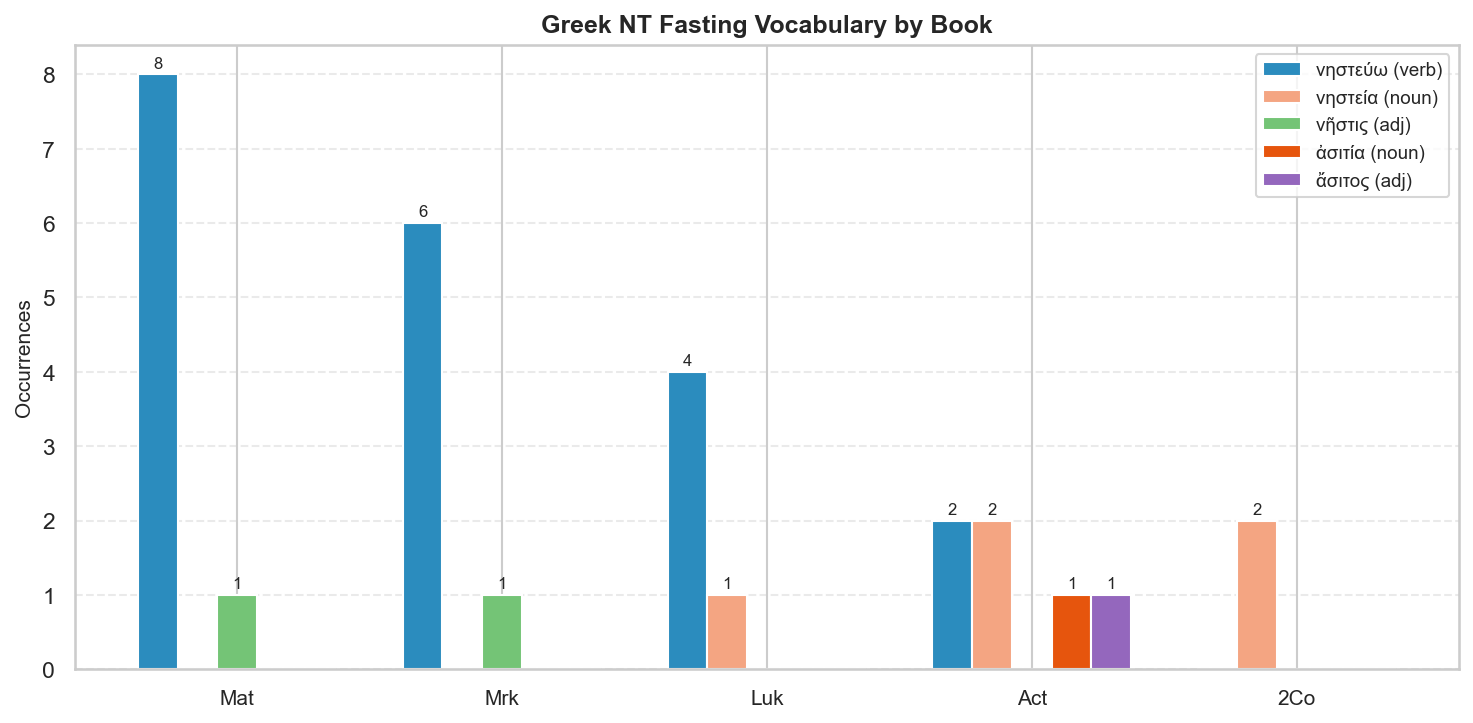
| Book | νηστεύω | νηστεία | νῆστις | ἀσιτία/ἄσιτος | Total |
|---|---|---|---|---|---|
| Matthew | 8 | 1 | 1 | — | 10 |
| Mark | 6 | 1 | 1 | — | 8 |
| Luke | 4 | 1 | — | — | 5 |
| Acts | 3 | 2 | — | 2 | 7 |
| 1 Corinthians | — | 1 | — | — | 1 |
| 2 Corinthians | — | 2 | — | — | 2 |
| Total | 21 | 8 | 2 | 2 | 33 |
Key observations: - Matthew is the primary fasting gospel (10×), driven by the Sermon on the Mount (6:16–18), the controversy with John's disciples (9:14–15), and the feeding of the 4,000 (15:32). - Mark closely parallels Matthew on the controversy pericopes. - Luke includes these parallels plus the unique Anna pericope (Luk 2:37 — fasting as lifelong devotional practice). - Acts shows fasting as an early church practice: missionary commissioning (13:2–3), elder appointment (14:23), and the Day of Atonement reference (27:9). - Paul (1–2 Cor) uses νηστεία for involuntary hardship (2Co 6:5; 11:27) alongside voluntary fasting.
4.3 The ἀσιτία / ἄσιτος Pair¶
These two hapax-like terms (Acts 27:21, 27:33) describe involuntary fasting aboard the storm-battered ship to Rome. Paul uses the situation as a platform for exhortation. The Abbot-Smith lexicon notes νηστεία is the synonym for ἀσιτία, distinguishing volitional from circumstantial food deprivation.
LXX background of the ἀσιτ- root: The ἀσιτ- family (α-privative + σῖτος, "food") does appear in the LXX, but only as the related verb ἀσιτέω (Est 4:16; 1 Mac 3:17) and adverb ἀσιτί (Job 24:6) — never as the noun ἀσιτία or adjective ἄσιτος that Paul uses. The LXX usage is consistent with Paul's register: ἀσιτέω in Est 4:16 is used alongside explicit fasting language as a near-synonym for "going without food," and ἀσιτί in Job 24:6 describes the poor who go hungry involuntarily — the same involuntary, circumstantial sense Paul invokes for the storm-tossed crew. See §3.4 for the full LXX analysis.
4.4 Key Passage Notes¶
| Passage | Notes |
|---|---|
| Mat 4:2 | Jesus fasts 40 days — deliberate parallel to Moses (Exod 34:28) and Elijah (1 Kgs 19:8) |
| Mat 6:16–18 | Sermon on the Mount: private fasting opposed to public performance |
| Mat 9:14–15 / Mrk 2:18–20 / Luk 5:33–35 | Controversy about fasting — "bridegroom" saying; implies fasting will resume after Jesus' departure |
| Luk 2:37 | Anna, the prophetess: fasting night and day as sustained intercessory devotion |
| Luk 18:12 | The Pharisee fasts twice a week — the standard Pharisaic practice (Monday/Thursday) |
| Act 13:2–3 | The Antioch church fasts during worship, receives prophetic word to commission Paul and Barnabas |
| Act 14:23 | Paul and Barnabas fast when appointing elders — fasting as part of leadership commissioning |
| Act 27:9 | "The Fast" = the Day of Atonement (Yom Kippur) — technical Jewish calendar usage |
| 2Co 6:5; 11:27 | Paul's hardship lists include νηστεία as apostolic suffering (involuntary deprivation) |
5. Cross-Testament Trajectory¶
5.1 The H6684/6685 → G3522/3521 Bridge¶
The LXX achieved a clean lexical bridge: the single Hebrew root (צ-ו-מ) was mapped to a single Greek root (νηστ-), and the NT inherited this vocabulary intact. Every NT use of fasting vocabulary is drawn from this LXX-established pair — there is no NT fasting term that lacks a clear LXX antecedent.
5.2 Development of Fasting Theology¶
| Period | Character | Key Texts |
|---|---|---|
| Early monarchy | Crisis-response: mourning, war, petition | Jdg 20:26; 1–2 Sam |
| Monarchy / Naboth affair | Royal fasting — both authentic and performed | 1 Kgs 21 |
| Psalms | Personal lament and devotional use | Psa 35; 69; 109 |
| Prophets | Critique of empty fasting; call to justice-fasting | Isa 58; Jer 14; Zec 7–8 |
| Late OT / exile era | Institutional commemorative fasts | Zec 7:5; 8:19; Dan 9:3 |
| Inter-testament | Pharisaic twice-weekly fasting (Luk 18:12); Didache 8:1 | |
| Gospels | Jesus modifies fasting: private, eschatological, bridegroom frame | Mat 6; 9; Luk 5 |
| Acts | Fasting as missional/ecclesial practice | Act 13–14 |
| Epistles | Fasting appears in hardship lists; marital fasting (1Co 7:5*) | 2Co 6; 11 |
5.3 The Aramaic Exception¶
The single Aramaic occurrence (Dan 6:18) stands apart. טְוָת is not used for religious fasting — it is Darius's anxious, involuntary night without food while Daniel is in the lion's den. It carries no ritual or devotional significance. This parallels the NT ἀσιτία / ἄσιτος pair in Acts 27, which likewise describes non-religious involuntary food deprivation.
6. Charts Index¶
| Chart | File |
|---|---|
| Cross-corpus totals summary | output/charts/both/word_studies/fasting/fasting_cross_corpus_summary.png |
| Hebrew OT by book (verb + noun) | output/charts/both/word_studies/fasting/fasting_hebrew_by_book.png |
| Hebrew verb conjugation distribution | output/charts/both/word_studies/fasting/fasting_hebrew_verb_morph.png |
| LXX by book | output/charts/both/word_studies/fasting/fasting_lxx_by_book.png |
| Greek NT by book | output/charts/both/word_studies/fasting/fasting_greek_nt_by_book.png |
7. Data Exports¶
| File | Contents | Rows |
|---|---|---|
| fasting_hebrew_ot.csv | All 47 OT Hebrew occurrences — ref, Hebrew text, Strong's, POS, morph, stem, gloss, LXX alignment, KJV verse | |
| fasting_aramaic_ot.csv | The single Aramaic occurrence (Dan 6:18 טְוָת H2908) — ref, text, morph, gloss, KJV verse | |
| fasting_lxx.csv | All 53 LXX occurrences — 50 core (νηστεύω / νηστεία) + 3 ἀσιτ- family (ἀσιτέω ×2, ἀσιτί ×1) — ref, Greek word, lemma, Strong's, POS, morph, KJV verse | |
| fasting_greek_nt.csv | All 29 Greek NT occurrences of the five fasting lemmas — ref, Greek word, lemma, Strong's, POS, morph, tense/voice/mood, gloss, KJV verse |
Regenerate with: python3 scripts/build_fasting_report.py