Nouns by Gender, Per Book
Build script: scripts/both/lexicon/build_nouns_by_gender.py
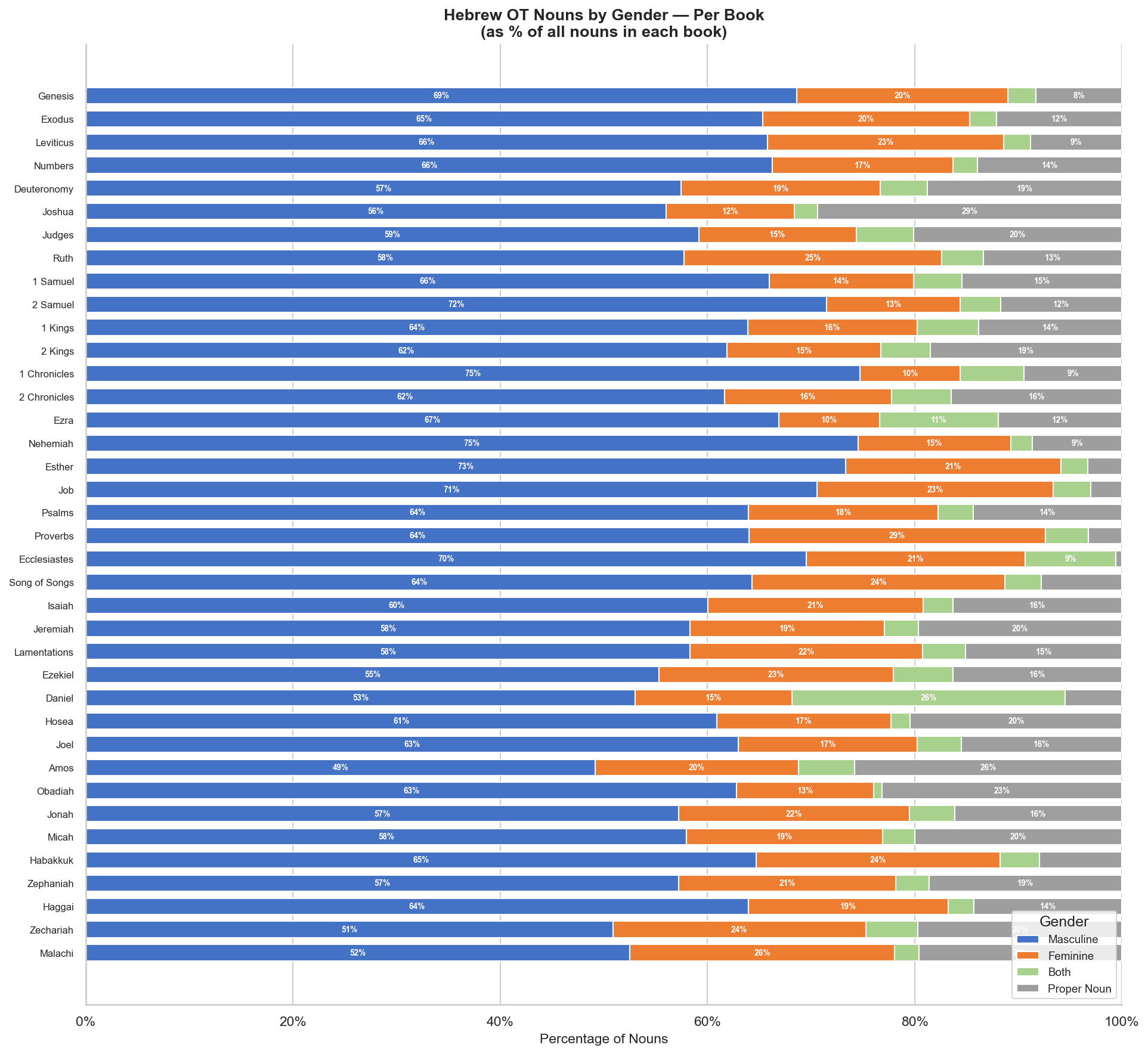
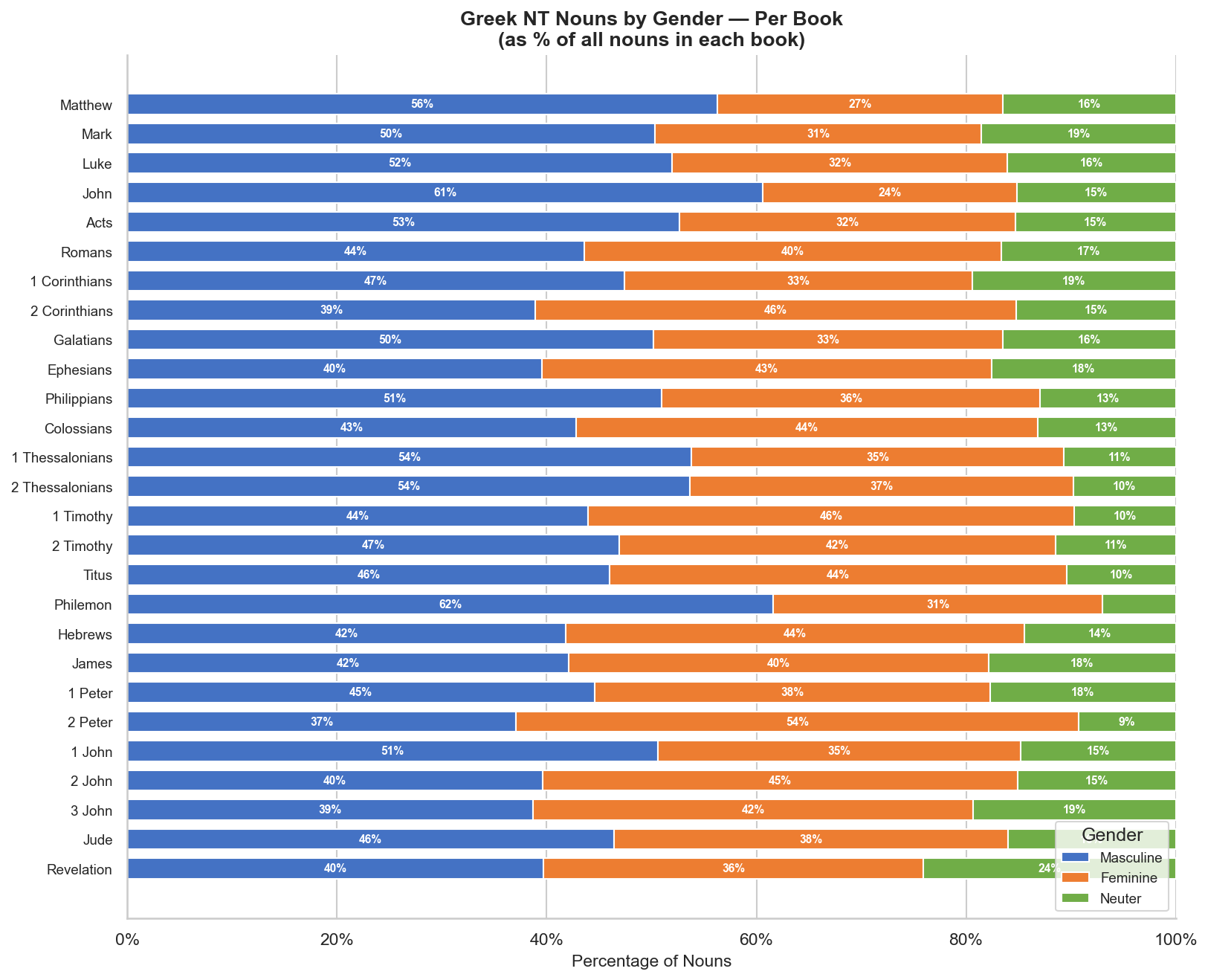
Noun gender distribution across every book of the Hebrew OT and Greek NT, shown as a percentage of all nouns in that book.
Hebrew Old Testament
Gender categories:
- Masculine — grammatically masculine nouns
- Feminine — grammatically feminine nouns
- Both — nouns with both masculine and feminine forms attested (or common gender)
- Proper Noun — proper nouns: place names (l code) and divine/personal names (t code)
Chart
Data Table
| Book | Masculine | Feminine | Both | Proper Noun | Total Nouns |
|---|---|---|---|---|---|
| Genesis | 68.6% | 20.4% | 2.7% | 8.3% | 7,465 |
| Exodus | 65.3% | 20.0% | 2.6% | 12.1% | 6,903 |
| Leviticus | 65.8% | 22.8% | 2.6% | 8.8% | 4,599 |
| Numbers | 66.3% | 17.4% | 2.4% | 14.0% | 7,675 |
| Deuteronomy | 57.4% | 19.2% | 4.5% | 18.8% | 4,817 |
| Joshua | 56.0% | 12.4% | 2.3% | 29.4% | 4,744 |
| Judges | 59.2% | 15.2% | 5.5% | 20.1% | 4,133 |
| Ruth | 57.8% | 24.9% | 4.0% | 13.4% | 374 |
| 1 Samuel | 66.0% | 13.9% | 4.7% | 15.4% | 5,191 |
| 2 Samuel | 71.5% | 12.9% | 3.9% | 11.7% | 4,681 |
| 1 Kings | 63.9% | 16.4% | 5.9% | 13.9% | 5,826 |
| 2 Kings | 61.9% | 14.9% | 4.7% | 18.5% | 5,492 |
| 1 Chronicles | 74.7% | 9.7% | 6.2% | 9.4% | 6,690 |
| 2 Chronicles | 61.6% | 16.1% | 5.8% | 16.5% | 6,697 |
| Ezra | 66.9% | 9.7% | 11.5% | 11.9% | 1,787 |
| Nehemiah | 74.5% | 14.7% | 2.1% | 8.6% | 2,568 |
| Esther | 73.4% | 20.8% | 2.6% | 3.3% | 1,445 |
| Job | 70.6% | 22.8% | 3.6% | 3.0% | 2,506 |
| Psalms | 64.0% | 18.3% | 3.4% | 14.4% | 6,835 |
| Proverbs | 64.0% | 28.6% | 4.2% | 3.2% | 2,796 |
| Ecclesiastes | 69.5% | 21.2% | 8.7% | 0.6% | 1,063 |
| Song of Songs | 64.3% | 24.4% | 3.5% | 7.8% | 451 |
| Isaiah | 60.0% | 20.8% | 2.9% | 16.3% | 6,468 |
| Jeremiah | 58.3% | 18.8% | 3.3% | 19.6% | 8,583 |
| Lamentations | 58.3% | 22.5% | 4.2% | 15.1% | 530 |
| Ezekiel | 55.3% | 22.6% | 5.8% | 16.3% | 7,178 |
| Daniel | 53.0% | 15.1% | 26.4% | 5.5% | 1,695 |
| Hosea | 60.9% | 16.8% | 1.9% | 20.4% | 847 |
| Joel | 63.0% | 17.2% | 4.2% | 15.5% | 400 |
| Amos | 49.1% | 19.7% | 5.4% | 25.8% | 875 |
| Obadiah | 62.8% | 13.2% | 0.8% | 23.1% | 121 |
| Jonah | 57.2% | 22.3% | 4.4% | 16.2% | 229 |
| Micah | 58.0% | 18.9% | 3.1% | 20.0% | 545 |
| Habakkuk | 64.7% | 23.5% | 3.8% | 8.0% | 238 |
| Zephaniah | 57.2% | 20.9% | 3.2% | 18.6% | 339 |
| Haggai | 63.9% | 19.3% | 2.5% | 14.3% | 280 |
| Zechariah | 50.9% | 24.4% | 5.0% | 19.7% | 1,278 |
| Malachi | 52.5% | 25.6% | 2.3% | 19.6% | 301 |
Greek New Testament
Gender categories: Masculine, Feminine, Neuter (standard Greek grammatical gender).
Chart
Data Table
| Book | Masculine | Feminine | Neuter | Total Nouns |
|---|---|---|---|---|
| Matthew | 56.3% | 27.3% | 16.5% | 3,701 |
| Mark | 50.3% | 31.2% | 18.5% | 2,079 |
| Luke | 52.0% | 32.0% | 16.1% | 3,733 |
| John | 60.6% | 24.3% | 15.1% | 2,766 |
| Acts | 52.7% | 32.0% | 15.3% | 4,259 |
| Romans | 43.6% | 39.8% | 16.7% | 1,705 |
| 1 Corinthians | 47.4% | 33.2% | 19.4% | 1,413 |
| 2 Corinthians | 38.9% | 45.9% | 15.2% | 900 |
| Galatians | 50.2% | 33.3% | 16.5% | 546 |
| Ephesians | 39.6% | 42.9% | 17.6% | 632 |
| Philippians | 51.0% | 36.1% | 12.9% | 363 |
| Colossians | 42.8% | 44.0% | 13.2% | 402 |
| 1 Thessalonians | 53.8% | 35.5% | 10.7% | 327 |
| 2 Thessalonians | 53.7% | 36.6% | 9.8% | 205 |
| 1 Timothy | 44.0% | 46.3% | 9.7% | 423 |
| 2 Timothy | 46.9% | 41.6% | 11.5% | 322 |
| Titus | 46.0% | 43.6% | 10.4% | 163 |
| Philemon | 61.6% | 31.4% | 7.0% | 86 |
| Hebrews | 41.8% | 43.7% | 14.5% | 1,196 |
| James | 42.1% | 40.1% | 17.9% | 392 |
| 1 Peter | 44.5% | 37.7% | 17.7% | 440 |
| 2 Peter | 37.1% | 53.6% | 9.3% | 302 |
| 1 John | 50.6% | 34.6% | 14.8% | 405 |
| 2 John | 39.6% | 45.3% | 15.1% | 53 |
| 3 John | 38.7% | 41.9% | 19.4% | 31 |
| Jude | 46.4% | 37.6% | 16.0% | 125 |
| Revelation | 39.7% | 36.3% | 24.1% | 2,399 |
Observations
Hebrew OT
- Masculine nouns dominate every book, typically 50–75% of all nouns — consistent with Hebrew's masculine-default grammar.
- Books with high proper noun rates tend to be geographically dense: Joshua (29.4%), Amos (25.8%), Obadiah (23.1%) — reflecting extensive lists of place names, tribal territories, or nations addressed.
- 1 Chronicles and Nehemiah have the highest masculine rates (74–75%), driven by the genealogical lists and census data which are heavy in personal names (classified as masculine proper nouns in the morphology).
- Proverbs stands out with the highest feminine rate (28.6%), consistent with its personification of Wisdom (חָכְמָה, Hokmah) and Folly as feminine figures addressed throughout.
- Daniel's "Both" spike (26.4%) is an artifact of Daniel's bilingual nature: Aramaic sections (Dan 2:4–7:28) carry some morphology codes that map to the "Both" category differently from Hebrew nouns. Daniel has the lowest masculine rate in the OT (53%).
Greek NT
- The Gospels and Acts lean masculine-heavy (50–61%), partly because of the high density of personal names and titles (Ἰησοῦς, κύριος, etc.).
- The Pauline epistles show notably high feminine rates — 2 Corinthians (45.9%), Ephesians (42.9%), Colossians (44.0%), 1 Timothy (46.3%) — reflecting abstract theological vocabulary (ἐκκλησία, χάρις, δικαιοσύνη, πίστις) which is largely feminine in Greek.
- 2 Peter has the highest feminine rate (53.6%), and Revelation the highest neuter rate (24.1%) — Revelation's neuter density reflects its heavy use of neuter symbols and abstract nouns (θηρίον, πνεῦμα, etc.).
- John's Gospel is the most masculine-heavy NT book (60.6%), consistent with its focus on λόγος, θεός, and personal christological discourse.
Source: STEPBible TAHOT/TAGNT (CC BY).
Charts: output/charts/nouns-by-gender-ot.png, output/charts/nouns-by-gender-nt.png.