Psalm 119 — Word Vocabulary and Thematic Analysis
Psalm 119 is the longest chapter in the Bible (176 verses) and the most elaborate alphabetic acrostic in the Hebrew scriptures: 22 stanzas of 8 verses each, one stanza for every letter of the Hebrew alphabet. Its subject is singular — the word of God — explored through 8 interlocking vocabulary terms, a rich cascade of petitions, and recurring emotional themes.
Contents
- Structure: The Acrostic Poem
- Word Vocabulary Analysis
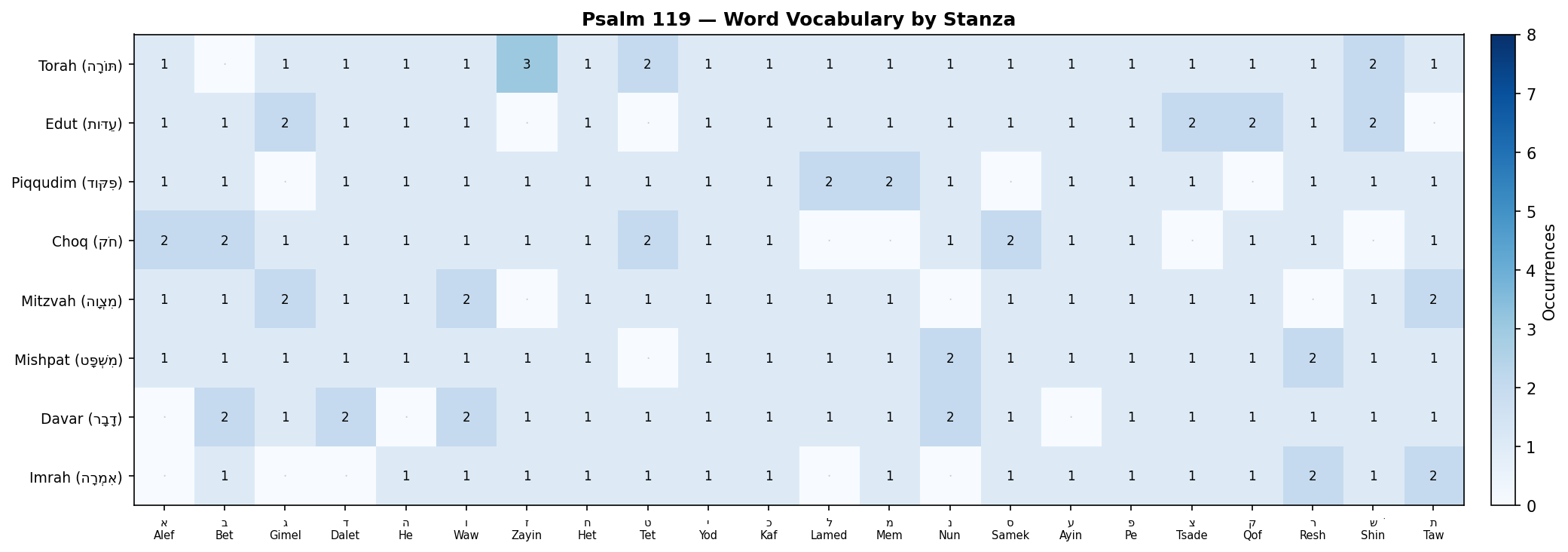
- Word Vocabulary by Stanza
- Requests and Petitions to God
- The Psalmist's Own Verbs
- Affirmations of Love and Devotion
- Lament: Affliction and Enemies
- Seeking, Longing, and Hope
- Praise and Testimony
- Meditation on God's Word
- Thematic Map by Stanza
- Charts
Key Observations
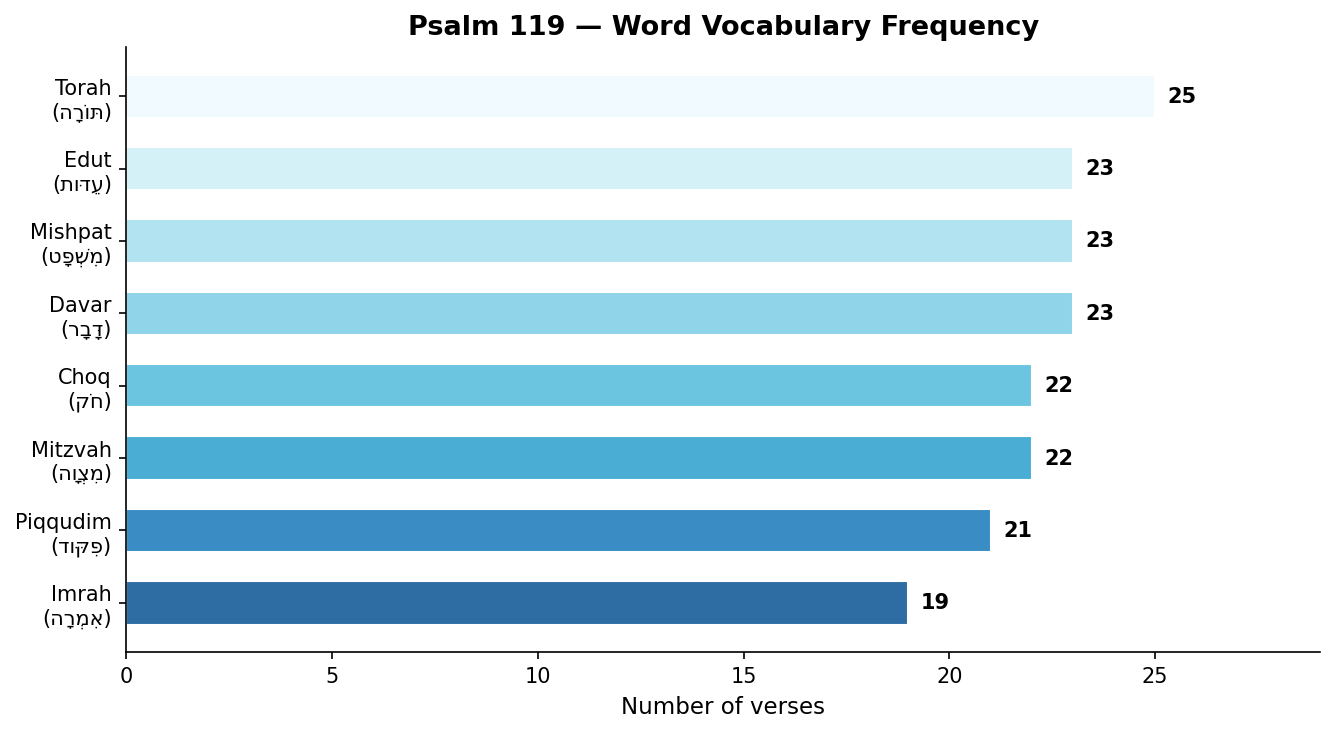
- Torah (תּוֹרָה) is the most frequent Word term, appearing in 25 of the psalm's 176 verses — roughly once every 7 verses on average.
- 58 verses (out of 176) contain at least one petition to God. The most repeated single verb is ḥayyenî ("revive / preserve me alive") — 9 times — revealing the psalmist's deepest felt need as spiritual life from God.
- The two terms for teaching (lammdenî = "teach me" and havinênî = "give me understanding") together account for 13 petition verbs — more than any other category. The psalmist's most urgent desire is not rescue but comprehension of God's word.
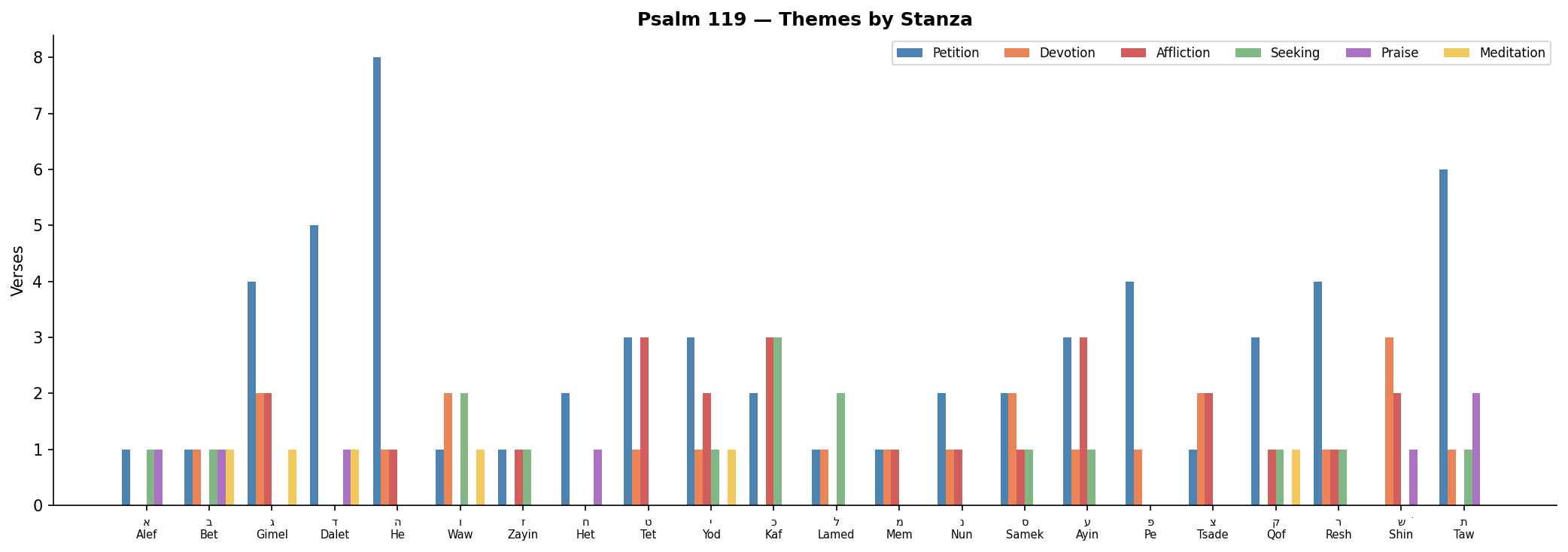
- Affliction and enemies appear throughout but cluster especially in the final stanzas (Resh–Taw, vv. 153–176), where petitions for deliverance also intensify.
- No single stanza lacks a Word vocabulary term. Even the stanzas with the fewest term occurrences (typically 5–6) still weave in every major synonym at least once across the stanza's 8 verses.
- Devotion and seeking overlap substantially: many verses that express love for God's word also express earnest pursuit. The two themes form the emotional spine of the psalm alongside the petition voice.
- שָׁמַר (keep/observe) is the most frequent non-petition verb (21 occurrences) and the only one whose direct objects span all 8 Torah vocabulary terms — it is the most comprehensive verb of covenant faithfulness in the psalm. Alongside it, אָהֵב (love) and שָׂנֵא (hate) form a devotional binary: the psalmist loves Torah's eight synonyms and hates falsehood, false paths, and half-heartedness.
Structure: The Acrostic Poem
Psalm 119 is a 22-stanza alphabetic acrostic. Each stanza consists of exactly 8 verses, and every verse in a stanza begins with the same Hebrew letter. The structure is relentless: 22 × 8 = 176 verses, surveying the whole scope of the poet's devotion to God's word from Alef to Taw — the Hebrew equivalent of A to Z.
| Stanza | Letter | Name | Verses |
|---|---|---|---|
| 1 | א | Alef | 1–8 |
| 2 | ב | Bet | 9–16 |
| 3 | ג | Gimel | 17–24 |
| 4 | ד | Dalet | 25–32 |
| 5 | ה | He | 33–40 |
| 6 | ו | Waw | 41–48 |
| 7 | ז | Zayin | 49–56 |
| 8 | ח | Het | 57–64 |
| 9 | ט | Tet | 65–72 |
| 10 | י | Yod | 73–80 |
| 11 | כ | Kaf | 81–88 |
| 12 | ל | Lamed | 89–96 |
| 13 | מ | Mem | 97–104 |
| 14 | נ | Nun | 105–112 |
| 15 | ס | Samek | 113–120 |
| 16 | ע | Ayin | 121–128 |
| 17 | פ | Pe | 129–136 |
| 18 | צ | Tsade | 137–144 |
| 19 | ק | Qof | 145–152 |
| 20 | ר | Resh | 153–160 |
| 21 | שׁ | Shin | 161–168 |
| 22 | ת | Taw | 169–176 |
Word Vocabulary Analysis
Eight distinct Hebrew nouns are used interchangeably throughout Psalm 119 as synonyms for God's revealed word. Together they appear approximately 178 times across the psalm's 176 verses. Scholars disagree on whether these terms carry distinct nuances or function as pure synonyms; the analysis below presents each term's usage and frequency.
| Term | Hebrew | English | Verses |
|---|---|---|---|
| Torah | תּוֹרָה | Law / Instruction | 25 |
| Edut | עֵדוּת | Testimonies | 23 |
| Mishpat | מִשְׁפָּט | Judgments / Rules | 23 |
| Davar | דָּבָר | Word / Promise | 23 |
| Choq | חֹק | Statutes | 22 |
| Mitzvah | מִצְוָה | Commandments | 22 |
| Piqqudim | פִּקּוּד | Precepts | 21 |
| Imrah | אִמְרָה | Word / Saying | 19 |
Term Descriptions
Torah (תּוֹרָה) — Law / Instruction · 25 verses
The foundational term for God's revealed instruction. Encompasses both specific commandments and the whole of divine teaching. The psalmist's love for the Torah frames the entire poem (vv. 1, 97, 165).
Edut (עֵדוּת) — Testimonies · 23 verses
God's testimonies or decrees — utterances that bear witness to his character and will. The noun is always plural in Psalm 119, emphasizing the fullness of what God has declared.
Piqqudim (פִּקּוּד) — Precepts · 21 verses
Specific charges or directives entrusted to Israel. The word conveys a sense of personal assignment and accountability for each command given.
Choq (חֹק) — Statutes · 22 verses
Engraved or inscribed laws — fixed, unchangeable decrees. The image of engraving underscores the permanent authority of God's ordinances.
Mitzvah (מִצְוָה) — Commandments · 22 verses
Direct divine commands, stressing the authoritative source. The psalmist runs in the way of the mitzvot and lifts his hands toward them (vv. 32, 48).
Mishpat (מִשְׁפָּט) — Judgments / Rules · 23 verses
Judicial decisions and ordinances grounded in God's role as righteous judge. The psalmist praises God's mishpatim even at midnight (v. 62).
Davar (דָּבָר) — Word / Promise · 23 verses
The divine word or promise. In Psalm 119 the davar is both God's command and his pledged faithfulness — the ground of the psalmist's hope (vv. 25, 107, 169).
Imrah (אִמְרָה) — Word / Saying · 19 verses
A spoken utterance or saying. Imrah often highlights the personal, direct character of God's speech and is used in parallel with davar. The psalmist's soul faints for God's imrah (v. 81).
Word Vocabulary by Stanza
The table below shows how many verses in each stanza contain each Word term. A dot (·) indicates zero occurrences.
| Stanza | Vv. | Torah | Edut | Piqqudim | Choq | Mitzvah | Mishpat | Davar | Imrah | Total |
|---|---|---|---|---|---|---|---|---|---|---|
| א Alef | 1–8 | 1 | 1 | 1 | 2 | 1 | 1 | · | · | 7 |
| ב Bet | 9–16 | · | 1 | 1 | 2 | 1 | 1 | 2 | 1 | 9 |
| ג Gimel | 17–24 | 1 | 2 | · | 1 | 2 | 1 | 1 | · | 8 |
| ד Dalet | 25–32 | 1 | 1 | 1 | 1 | 1 | 1 | 2 | · | 8 |
| ה He | 33–40 | 1 | 1 | 1 | 1 | 1 | 1 | · | 1 | 7 |
| ו Waw | 41–48 | 1 | 1 | 1 | 1 | 2 | 1 | 2 | 1 | 10 |
| ז Zayin | 49–56 | 3 | · | 1 | 1 | · | 1 | 1 | 1 | 8 |
| ח Het | 57–64 | 1 | 1 | 1 | 1 | 1 | 1 | 1 | 1 | 8 |
| ט Tet | 65–72 | 2 | · | 1 | 2 | 1 | · | 1 | 1 | 8 |
| י Yod | 73–80 | 1 | 1 | 1 | 1 | 1 | 1 | 1 | 1 | 8 |
| כ Kaf | 81–88 | 1 | 1 | 1 | 1 | 1 | 1 | 1 | 1 | 8 |
| ל Lamed | 89–96 | 1 | 1 | 2 | · | 1 | 1 | 1 | · | 7 |
| מ Mem | 97–104 | 1 | 1 | 2 | · | 1 | 1 | 1 | 1 | 8 |
| נ Nun | 105–112 | 1 | 1 | 1 | 1 | · | 2 | 2 | · | 8 |
| ס Samek | 113–120 | 1 | 1 | · | 2 | 1 | 1 | 1 | 1 | 8 |
| ע Ayin | 121–128 | 1 | 1 | 1 | 1 | 1 | 1 | · | 1 | 7 |
| פ Pe | 129–136 | 1 | 1 | 1 | 1 | 1 | 1 | 1 | 1 | 8 |
| צ Tsade | 137–144 | 1 | 2 | 1 | · | 1 | 1 | 1 | 1 | 8 |
| ק Qof | 145–152 | 1 | 2 | · | 1 | 1 | 1 | 1 | 1 | 8 |
| ר Resh | 153–160 | 1 | 1 | 1 | 1 | · | 2 | 1 | 2 | 9 |
| שׁ Shin | 161–168 | 2 | 2 | 1 | · | 1 | 1 | 1 | 1 | 9 |
| ת Taw | 169–176 | 1 | · | 1 | 1 | 2 | 1 | 1 | 2 | 9 |
Requests and Petitions to God
Psalm 119 is saturated with direct petition. Across 58 verses, the psalmist addresses God with imperative verbs or jussive forms that express wishes and requests. These petitions reveal both the psalmist's need and his theology: he does not merely obey God's word — he pleads with God to enable him to live it.
Most-Repeated Petition Verbs
| Verb (gloss) | Times |
|---|---|
| Preserve alive me | 9 |
| Teach me | 8 |
| Give understanding me | 5 |
| Take away | 3 |
| Show favor to me | 2 |
| May it be | 2 |
| Save me | 2 |
| See | 2 |
| Forsake me | 1 |
| Deal bountifully | 1 |
| Uncover | 1 |
| Hide | 1 |
Petitions by Category
Teach & Illuminate
Petitions for understanding, instruction, and revelation
Ps 119:12 · לַמְּדֵ֥/נִי — teach me\ Blessed art thou, O Lord: teach me thy statutes.
Ps 119:26 · לַמְּדֵ֥/נִי — teach me\ I have declared my ways, and thou heardest me: teach me thy statutes.
Ps 119:27 · הֲבִינֵ֑/נִי — give understanding of me\ Make me to understand the way of thy precepts: so shall I talk of thy wondrous works.
Ps 119:29 · הָסֵ֣ר — remove (Hiphil) | חָנֵּֽ/נִי\׃ — show favor to me\ Remove from me the way of lying: and grant me thy law graciously.
Ps 119:33 · הוֹרֵ֣/נִי — teach me\ Teach me, O Lord, the way of thy statutes; and I shall keep it unto the end.
Ps 119:34 · הֲ֭בִינֵ/נִי — give understanding me\ Give me understanding, and I shall keep thy law; yea, I shall observe it with my whole heart.
Ps 119:35 · הַ֭דְרִיכֵ/נִי — lead me\ Make me to go in the path of thy commandments; for therein do I delight.
Ps 119:58 · חָ֝נֵּ֗/נִי — show favor to me\ I intreated thy favour with my whole heart: be merciful unto me according to thy word.
Ps 119:64 · לַמְּדֵֽ/נִי\׃ — teach me\ The earth, O Lord, is full of thy mercy: teach me thy statutes.
Ps 119:66 · לַמְּדֵ֑/נִי — teach me\ Teach me good judgment and knowledge: for I have believed thy commandments.
Ps 119:68 · לַמְּדֵ֥/נִי — teach me\ Thou art good, and doest good; teach me thy statutes.
Ps 119:73 · הֲ֝בִינֵ֗/נִי — give understanding me\ Thy hands have made me and fashioned me: give me understanding, that I may learn thy commandments.
Ps 119:108 · רְצֵה\־ — accept (Qal) | לַמְּדֵֽ/נִי\׃ — teach me\ Accept, I beseech thee, the freewill offerings of my mouth, O Lord, and teach me thy judgments.
Ps 119:124 · עֲשֵׂ֖ה — do (Qal) | לַמְּדֵֽ/נִי\׃ — teach me\ Deal with thy servant according unto thy mercy, and teach me thy statutes.
Ps 119:125 · הֲבִינֵ֑/נִי — give understanding me\ I am thy servant; give me understanding, that I may know thy testimonies.
Ps 119:133 · הָכֵ֣ן — direct (Hiphil)\ Order my steps in thy word: and let not any iniquity have dominion over me.
Ps 119:135 · הָאֵ֣ר — make shine (Hiphil)\ Make thy face to shine upon thy servant; and teach me thy statutes.
Ps 119:144 · הֲבִינֵ֥/נִי — give understanding me\ The righteousness of thy testimonies is everlasting: give me understanding, and I shall live.
Ps 119:169 · הֲבִינֵֽ/נִי\׃ — give understanding me\ Let my cry come near before thee, O Lord: give me understanding according to thy word.
Revive & Strengthen
Petitions for life, renewal, and endurance
Ps 119:25 · חַ֝יֵּ֗/נִי — preserve alive me\ My soul cleaveth unto the dust: quicken thou me according to thy word.
Ps 119:28 · קַ֝יְּמֵ֗/נִי — strengthen me\ My soul melteth for heaviness: strengthen thou me according unto thy word.
Ps 119:37 · הַעֲבֵ֣ר — take away (Hiphil) | חַיֵּֽ/נִי\׃ — preserve alive me\ Turn away mine eyes from beholding vanity; and quicken thou me in thy way.
Ps 119:40 · חַיֵּֽ/נִי\׃ — preserve alive me\ Behold, I have longed after thy precepts: quicken me in thy righteousness.
Ps 119:88 · חַיֵּ֑/נִי — preserve alive me\ Quicken me after thy lovingkindness; so shall I keep the testimony of thy mouth.
Ps 119:107 · חַיֵּ֥/נִי — preserve alive me\ I am afflicted very much: quicken me, O Lord, according unto thy word.
Ps 119:116 · סָמְכֵ֣/נִי — sustain me\ Uphold me according unto thy word, that I may live: and let me not be ashamed of my hope.
Ps 119:117 · סְעָדֵ֥/נִי — uphold me\ Hold thou me up, and I shall be safe: and I will have respect unto thy statutes continually.
Ps 119:149 · שִׁמְעָ֣/ה — hear | חַיֵּֽ/נִי\׃ — preserve alive me\ Hear my voice according unto thy lovingkindness: O Lord, quicken me according to thy judgment.
Ps 119:154 · רִיבָ֣/ה — conduct | חַיֵּֽ/נִי\׃ — preserve alive me\ Plead my cause, and deliver me: quicken me according to thy word.
Ps 119:156 · חַיֵּֽ/נִי\׃ — preserve alive me\ Great are thy tender mercies, O Lord: quicken me according to thy judgments.
Ps 119:159 · רְ֭אֵה — see (Qal) | חַיֵּֽ/נִי\׃ — preserve alive me\ Consider how I love thy precepts: quicken me, O Lord, according to thy lovingkindness.
Ps 119:170 · הַצִּילֵֽ/נִי\׃ — deliver me\ Let my supplication come before thee: deliver me according to thy word.
Ps 119:175 · תְּֽחִי\־ — may it live (Qal)\ Let my soul live, and it shall praise thee; and let thy judgments help me.
Save & Deliver
Petitions for rescue from affliction and enemies
Ps 119:86 · עָזְרֵֽ/נִי\׃ — help me\ All thy commandments are faithful: they persecute me wrongfully; help thou me.
Ps 119:94 · הוֹשִׁיעֵ֑/נִי — save me\ I am thine, save me; for I have sought thy precepts.
Ps 119:134 · פְּ֭דֵ/נִי — redeem me\ Deliver me from the oppression of man: so will I keep thy precepts.
Ps 119:145 · עֲנֵ֥/נִי — answer me\ I cried with my whole heart; hear me, O Lord: I will keep thy statutes.
Ps 119:146 · הוֹשִׁיעֵ֑/נִי — save me\ I cried unto thee; save me, and I shall keep thy testimonies.
Ps 119:154 · רִיבָ֣/ה — conduct | חַיֵּֽ/נִי\׃ — preserve alive me\ Plead my cause, and deliver me: quicken me according to thy word.
Grace & Attention
Petitions for God's face, favor, and attentiveness
Ps 119:49 · זְכֹר\־ — remember (Qal)\ Remember the word unto thy servant, upon which thou hast caused me to hope.
Ps 119:108 · רְצֵה\־ — accept (Qal) | לַמְּדֵֽ/נִי\׃ — teach me\ Accept, I beseech thee, the freewill offerings of my mouth, O Lord, and teach me thy judgments.
Ps 119:132 · פְּנֵה\־ — turn (Qal)\ Look thou upon me, and be merciful unto me, as thou usest to do unto those that love thy name.
Ps 119:149 · שִׁמְעָ֣/ה — hear | חַיֵּֽ/נִי\׃ — preserve alive me\ Hear my voice according unto thy lovingkindness: O Lord, quicken me according to thy judgment.
Ps 119:153 · רְאֵֽה\־ — see (Qal)\ Consider mine affliction, and deliver me: for I do not forget thy law.
Ps 119:159 · רְ֭אֵה — see (Qal) | חַיֵּֽ/נִי\׃ — preserve alive me\ Consider how I love thy precepts: quicken me, O Lord, according to thy lovingkindness.
Ps 119:176 · בַּקֵּ֣שׁ — seek (Piel)\ I have gone astray like a lost sheep; seek thy servant; for I do not forget thy commandments.
Protect & Order
Petitions for God to act, direct, and guard
Ps 119:8 · תַּעַזְבֵ֥/נִי — you forsake me\ I will keep thy statutes: O forsake me not utterly.
Ps 119:17 · גְּמֹ֖ל — deal bountifully (Qal)\ Deal bountifully with thy servant, that I may live, and keep thy word.
Ps 119:19 · תַּסְתֵּ֥ר — you hide (Hiphil)\ I am a stranger in the earth: hide not thy commandments from me.
Ps 119:29 · הָסֵ֣ר — remove (Hiphil) | חָנֵּֽ/נִי\׃ — show favor to me\ Remove from me the way of lying: and grant me thy law graciously.
Ps 119:36 · הַט\־ — incline (Hiphil)\ Incline my heart unto thy testimonies, and not to covetousness.
Ps 119:37 · הַעֲבֵ֣ר — take away (Hiphil) | חַיֵּֽ/נִי\׃ — preserve alive me\ Turn away mine eyes from beholding vanity; and quicken thou me in thy way.
Ps 119:38 · הָקֵ֣ם — fulfill (Hiphil)\ Stablish thy word unto thy servant, who is devoted to thy fear.
Ps 119:39 · הַעֲבֵ֣ר — take away (Hiphil)\ Turn away my reproach which I fear: for thy judgments are good.
Ps 119:43 · תַּצֵּ֬ל — you take away (Hiphil)\ And take not the word of truth utterly out of my mouth; for I have hoped in thy judgments.
Ps 119:122 · עֲרֹ֣ב — stand surety for (Qal) | יַעַשְׁקֻ֥/נִי — they oppress me\ Be surety for thy servant for good: let not the proud oppress me.
Ps 119:124 · עֲשֵׂ֖ה — do (Qal) | לַמְּדֵֽ/נִי\׃ — teach me\ Deal with thy servant according unto thy mercy, and teach me thy statutes.
Other
Additional petitions
Ps 119:18 · גַּל\־ — uncover (Piel)\ Open thou mine eyes, that I may behold wondrous things out of thy law.
Ps 119:22 · גַּ֣ל — roll away (Piel)\ Remove from me reproach and contempt; for I have kept thy testimonies.
Ps 119:71 · אֶלְמַ֥ד — I may learn (Qal)\ It is good for me that I have been afflicted; that I might learn thy statutes.
Ps 119:76 · יְהִי\־ — let it be (Qal)\ Let, I pray thee, thy merciful kindness be for my comfort, according to thy word unto thy servant.
Ps 119:80 · יְהִֽי\־ — may it be (Qal)\ Let my heart be sound in thy statutes; that I be not ashamed.
Ps 119:101 · אֶשְׁמֹ֥ר — I may keep (Qal)\ I have refrained my feet from every evil way, that I might keep thy word.
Ps 119:122 · עֲרֹ֣ב — stand surety for (Qal) | יַעַשְׁקֻ֥/נִי — they oppress me\ Be surety for thy servant for good: let not the proud oppress me.
Ps 119:172 · תַּ֣עַן — may it sing (Qal)\ My tongue shall speak of thy word: for all thy commandments are righteousness.
Ps 119:173 · תְּהִֽי\־ — may it be (Qal)\ Let thine hand help me; for I have chosen thy precepts.
The Psalmist's Own Verbs
Alongside his petitions to God, the psalmist declares what he himself does. These non-petition verb forms — 273 tokens across the psalm — reveal the psalmist's active posture toward God's word and form the obverse of the petition voice: he asks God to help him keep, love, and understand Torah, but he also affirms that he already does so.
Most-Frequent Declared Actions
| Verb (English) | Hebrew | N | Primary Object |
|---|---|---|---|
| Keep / Observe | שָׁמַר | 21 | Edut (4×) |
| Love | אָהֵב | 12 | Torah (4×) |
| Observe / Guard | נָצַר | 10 | Piqqudim (3×) |
| Forget (negated) | שָׁכַח | 9 | Torah (3×) |
| Do / Make | עָשָׂה | 7 | — |
| Live | חָיָה | 7 | — |
| Wait / Hope | יָחַל | 6 | — |
| Meditate | שִׂיחַ | 6 | — |
| Pursue | רָדַף | 5 | — |
| Learn | לָמַד | 5 | Choq (2×) |
| Seek | דָּרַשׁ | 5 | Piqqudim (2×) |
| Afflict | עָנָה | 4 | — |
What the Psalmist Keeps, Loves, and Observes
The six Torah-directed verbs (keep, love, observe, not-forget, learn, seek) all take the eight canonical Torah vocabulary terms as direct objects. The matrix below shows how many times each verb governs each term.
| Verb | Torah | Edut | Piqqudim | Choq | Mitzvah | Mishpat | Davar | Imrah | Total |
|---|---|---|---|---|---|---|---|---|---|
| שָׁמַר (Keep) | 3 | 4 | 3 | 2 | 1 | 1 | 3 | 2 | 19 |
| אָהֵב (Love) | 4 | 1 | 1 | · | 3 | · | · | · | 9 |
| נָצַר (Observe) | 1 | 2 | 3 | 1 | 1 | · | · | · | 8 |
| שָׁכַח (Forget*) | 3 | · | 2 | 1 | 1 | · | 2 | · | 9 |
| לָמַד (Learn) | · | · | · | 2 | 1 | 1 | · | · | 4 |
| דָּרַשׁ (Seek) | · | · | 2 | 1 | · | · | · | · | 3 |
* שָׁכַח (forget) is always negated in Psalm 119 — "I will not forget your law/word." All nine occurrences are negated declarations of faithfulness, not admissions of failure.
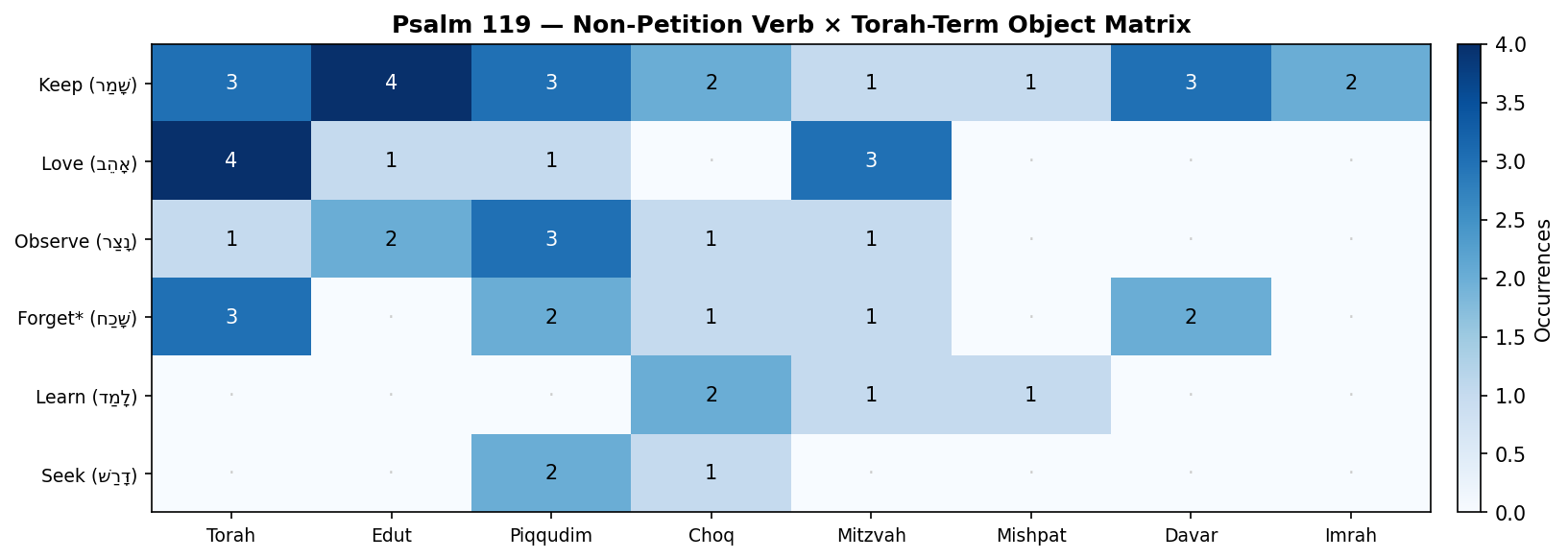
שָׁמַר (keep/observe) stands out: with 21 occurrences it is the most frequent non-petition verb, and its objects span all 8 Torah vocabulary terms — the only verb in the psalm that governs the entire Torah synonymy:
- Torah — 3× (vv. 44, 55, 136)
- Edut — 4× (vv. 88, 146, 167, 168)
- Piqqudim — 3× (vv. 63, 134, 168)
- Choq — 2× (vv. 5, 8)
- Mitzvah — 1× (vv. 60)
- Mishpat — 1× (vv. 106)
- Davar — 3× (vv. 17, 57, 101)
- Imrah — 2× (vv. 67, 158)
אָהֵב (love) concentrates on מִצְוָה (commandments, 3×) and תּוֹרָה (Torah, 3×), anchoring the psalmist's affective devotion in the two most foundational Torah terms.
שָׁכַח (forget) — always negated — takes תּוֹרָה (3×) and דָּבָר / פִּקּוּדִים / מִצְוָה as objects. The psalmist's most consistent negative declaration is precisely that he does not forget God's word.
What the Psalmist Hates
שָׂנֵא (hate, 4 occurrences) takes exclusively negative objects — a binary counterpart to the love vocabulary:
| Verse | Object | Gloss |
|---|---|---|
| 104 | אֹרַח | false path |
| 113 | סֵעֵף | half-hearted people |
| 128 | אֹרַח | false path |
| 163 | שֶׁקֶר | falsehood |
The psalmist loves every Torah synonym; he hates every form of deception and half-heartedness. The binary is sharp and deliberate.
Affirmations of Love and Devotion
The psalmist does not merely keep God's commandments — he loves them. Love (H157, אָהַב) and delight (H2654, חָפֵץ; H7521, רָצָה) vocabulary appears in 22 verses, expressing an affective, not merely legal, relationship to God's word.
| Verse | KJV Text |
|---|---|
| Ps 119:16 | I will delight myself in thy statutes: I will not forget thy word. |
| Ps 119:23 | Princes also did sit and speak against me: but thy servant did meditate in thy statutes. |
| Ps 119:24 | Thy testimonies also are my delight and my counsellors. |
| Ps 119:35 | Make me to go in the path of thy commandments; for therein do I delight. |
| Ps 119:47 | And I will delight myself in thy commandments, which I have loved. |
| Ps 119:48 | My hands also will I lift up unto thy commandments, which I have loved; and I will meditate in thy statutes. |
| Ps 119:70 | Their heart is as fat as grease; but I delight in thy law. |
| Ps 119:77 | Let thy tender mercies come unto me, that I may live: for thy law is my delight. |
| Ps 119:92 | Unless thy law had been my delights, I should then have perished in mine affliction. |
| Ps 119:97 | O how love I thy law! it is my meditation all the day. |
| Ps 119:108 | Accept, I beseech thee, the freewill offerings of my mouth, O Lord, and teach me thy judgments. |
| Ps 119:113 | I hate vain thoughts: but thy law do I love. |
| Ps 119:119 | Thou puttest away all the wicked of the earth like dross: therefore I love thy testimonies. |
| Ps 119:127 | Therefore I love thy commandments above gold; yea, above fine gold. |
| Ps 119:132 | Look thou upon me, and be merciful unto me, as thou usest to do unto those that love thy name. |
| Ps 119:140 | Thy word is very pure: therefore thy servant loveth it. |
| Ps 119:143 | Trouble and anguish have taken hold on me: yet thy commandments are my delights. |
| Ps 119:159 | Consider how I love thy precepts: quicken me, O Lord, according to thy lovingkindness. |
| Ps 119:163 | I hate and abhor lying: but thy law do I love. |
| Ps 119:165 | Great peace have they which love thy law: and nothing shall offend them. |
| Ps 119:167 | My soul hath kept thy testimonies; and I love them exceedingly. |
| Ps 119:174 | I have longed for thy salvation, O Lord; and thy law is my delight. |
Lament: Affliction and Enemies
The psalmist faces real opposition. Words for affliction (H6031, עָנָה), adversaries (H6862, צַר), enemies (H341, אֹיֵב), and persecution (H7291, רָדַף) appear in 24 verses. Far from trivializing suffering, Psalm 119 is partly a psalm of the persecuted faithful. The psalmist's clinging to God's word intensifies because he is under pressure.
| Verse | KJV Text |
|---|---|
| Ps 119:21 | Thou hast rebuked the proud that are cursed, which do err from thy commandments. |
| Ps 119:22 | Remove from me reproach and contempt; for I have kept thy testimonies. |
| Ps 119:39 | Turn away my reproach which I fear: for thy judgments are good. |
| Ps 119:51 | The proud have had me greatly in derision: yet have I not declined from thy law. |
| Ps 119:67 | Before I was afflicted I went astray: but now have I kept thy word. |
| Ps 119:69 | The proud have forged a lie against me: but I will keep thy precepts with my whole heart. |
| Ps 119:71 | It is good for me that I have been afflicted; that I might learn thy statutes. |
| Ps 119:75 | I know, O Lord, that thy judgments are right, and that thou in faithfulness hast afflicted me. |
| Ps 119:78 | Let the proud be ashamed; for they dealt perversely with me without a cause: but I will meditate in thy precepts. |
| Ps 119:84 | How many are the days of thy servant? when wilt thou execute judgment on them that persecute me? |
| Ps 119:85 | The proud have digged pits for me, which are not after thy law. |
| Ps 119:86 | All thy commandments are faithful: they persecute me wrongfully; help thou me. |
| Ps 119:104 | Through thy precepts I get understanding: therefore I hate every false way. |
| Ps 119:107 | I am afflicted very much: quicken me, O Lord, according unto thy word. |
| Ps 119:113 | I hate vain thoughts: but thy law do I love. |
| Ps 119:121 | I have done judgment and justice: leave me not to mine oppressors. |
| Ps 119:122 | Be surety for thy servant for good: let not the proud oppress me. |
| Ps 119:128 | Therefore I esteem all thy precepts concerning all things to be right; and I hate every false way. |
| Ps 119:139 | My zeal hath consumed me, because mine enemies have forgotten thy words. |
| Ps 119:143 | Trouble and anguish have taken hold on me: yet thy commandments are my delights. |
| Ps 119:150 | They draw nigh that follow after mischief: they are far from thy law. |
| Ps 119:157 | Many are my persecutors and mine enemies; yet do I not decline from thy testimonies. |
| Ps 119:161 | Princes have persecuted me without a cause: but my heart standeth in awe of thy word. |
| Ps 119:163 | I hate and abhor lying: but thy law do I love. |
Seeking, Longing, and Hope
Seeking vocabulary (H1875 דָּרַשׁ, H7836 שָׁחַר, H1245 בָּקַשׁ) and longing/waiting vocabulary (H6960 קָוָה, H3176 יָחַל, H3615 כָּלָה) appear in 16 verses. The psalmist is not passive; he actively pursues God and pines for his word with the urgency of physical thirst.
| Verse | KJV Text |
|---|---|
| Ps 119:2 | Blessed are they that keep his testimonies, and that seek him with the whole heart. |
| Ps 119:10 | With my whole heart have I sought thee: O let me not wander from thy commandments. |
| Ps 119:43 | And take not the word of truth utterly out of my mouth; for I have hoped in thy judgments. |
| Ps 119:45 | And I will walk at liberty: for I seek thy precepts. |
| Ps 119:49 | Remember the word unto thy servant, upon which thou hast caused me to hope. |
| Ps 119:74 | They that fear thee will be glad when they see me; because I have hoped in thy word. |
| Ps 119:81 | My soul fainteth for thy salvation: but I hope in thy word. |
| Ps 119:82 | Mine eyes fail for thy word, saying, When wilt thou comfort me? |
| Ps 119:87 | They had almost consumed me upon earth; but I forsook not thy precepts. |
| Ps 119:94 | I am thine, save me; for I have sought thy precepts. |
| Ps 119:95 | The wicked have waited for me to destroy me: but I will consider thy testimonies. |
| Ps 119:114 | Thou art my hiding place and my shield: I hope in thy word. |
| Ps 119:123 | Mine eyes fail for thy salvation, and for the word of thy righteousness. |
| Ps 119:147 | I prevented the dawning of the morning, and cried: I hoped in thy word. |
| Ps 119:155 | Salvation is far from the wicked: for they seek not thy statutes. |
| Ps 119:176 | I have gone astray like a lost sheep; seek thy servant; for I do not forget thy commandments. |
Praise and Testimony
Praise vocabulary (H1984 הָלַל, H3034 יָדָה, H5608 סָפַר, H7623 שָׁבַח) appears in 7 verses. The psalmist's devotion is not private; he commits to praising God and declaring his righteous ordinances "before kings" (v. 46) and teaching transgressors God's ways (v. 171).
| Verse | KJV Text |
|---|---|
| Ps 119:7 | I will praise thee with uprightness of heart, when I shall have learned thy righteous judgments. |
| Ps 119:13 | With my lips have I declared all the judgments of thy mouth. |
| Ps 119:26 | I have declared my ways, and thou heardest me: teach me thy statutes. |
| Ps 119:62 | At midnight I will rise to give thanks unto thee because of thy righteous judgments. |
| Ps 119:164 | Seven times a day do I praise thee because of thy righteous judgments. |
| Ps 119:171 | My lips shall utter praise, when thou hast taught me thy statutes. |
| Ps 119:175 | Let my soul live, and it shall praise thee; and let thy judgments help me. |
Meditation on God's Word
Two specific verbs mark intentional engagement with God's word: - שִׂיחַ (H7878, siaḥ) — meditate, muse, talk to oneself about something - הָגָה (H1897, hagah) — meditate, mutter, recite softly
These appear in 6 verses and describe the sustained, repeated turning of the mind to God's word — the practice underlying the whole psalm.
| Verse | KJV Text |
|---|---|
| Ps 119:15 | I will meditate in thy precepts, and have respect unto thy ways. |
| Ps 119:23 | Princes also did sit and speak against me: but thy servant did meditate in thy statutes. |
| Ps 119:27 | Make me to understand the way of thy precepts: so shall I talk of thy wondrous works. |
| Ps 119:48 | My hands also will I lift up unto thy commandments, which I have loved; and I will meditate in thy statutes. |
| Ps 119:78 | Let the proud be ashamed; for they dealt perversely with me without a cause: but I will meditate in thy precepts. |
| Ps 119:148 | Mine eyes prevent the night watches, that I might meditate in thy word. |
Thematic Map by Stanza
The table shows, for each stanza, how many verses contain each theme. A stanza with a high petition count alongside high affliction count often reveals a section of particular distress. Stanzas where devotion and seeking overlap mark peak expressions of the psalmist's love for God's word.
| Stanza | Vv. | Petitions | Devotion | Affliction | Seeking | Praise | Meditation |
|---|---|---|---|---|---|---|---|
| א Alef | 1–8 | 1 | · | · | 1 | 1 | · |
| ב Bet | 9–16 | 1 | 1 | · | 1 | 1 | 1 |
| ג Gimel | 17–24 | 4 | 2 | 2 | · | · | 1 |
| ד Dalet | 25–32 | 5 | · | · | · | 1 | 1 |
| ה He | 33–40 | 8 | 1 | 1 | · | · | · |
| ו Waw | 41–48 | 1 | 2 | · | 2 | · | 1 |
| ז Zayin | 49–56 | 1 | · | 1 | 1 | · | · |
| ח Het | 57–64 | 2 | · | · | · | 1 | · |
| ט Tet | 65–72 | 3 | 1 | 3 | · | · | · |
| י Yod | 73–80 | 3 | 1 | 2 | 1 | · | 1 |
| כ Kaf | 81–88 | 2 | · | 3 | 3 | · | · |
| ל Lamed | 89–96 | 1 | 1 | · | 2 | · | · |
| מ Mem | 97–104 | 1 | 1 | 1 | · | · | · |
| נ Nun | 105–112 | 2 | 1 | 1 | · | · | · |
| ס Samek | 113–120 | 2 | 2 | 1 | 1 | · | · |
| ע Ayin | 121–128 | 3 | 1 | 3 | 1 | · | · |
| פ Pe | 129–136 | 4 | 1 | · | · | · | · |
| צ Tsade | 137–144 | 1 | 2 | 2 | · | · | · |
| ק Qof | 145–152 | 3 | · | 1 | 1 | · | 1 |
| ר Resh | 153–160 | 4 | 1 | 1 | 1 | · | · |
| שׁ Shin | 161–168 | · | 3 | 2 | · | 1 | · |
| ת Taw | 169–176 | 6 | 1 | · | 1 | 2 | · |
Charts
| Chart | Description |
|---|---|
| Word Term Frequencies | Frequency of the 8 canonical Word terms across Psalm 119 |
| Word Vocabulary by Stanza | Heatmap: which terms appear in which stanzas |
| Themes by Stanza | Thematic distribution across all 22 stanzas |
| Verb × Torah-Term Object Matrix | Which Torah terms each key non-petition verb governs |
Data source: Macula-Hebrew (OSHB); English text: KJV.