Hiphil (הִפְעִיל) Verb Morphology — Biblical Hebrew
Build script: scripts/ot/verbs/build_hiphil_report.py
Generated from MACULA Hebrew WLC data
1. Overview
The Hiphil stem expresses causative or declarative action. It is formed with a prefixed ה (hé) in the perfect and special vowel patterns in other conjugations. The Hiphil is the second most productive derived stem after the Piel.
| Statistic | Value |
|---|---|
| Total Hiphil tokens (OT) | 9,409 |
| % of all OT verb tokens | 12.9% |
| Unique roots in Hiphil | 479 |
| Books containing Hiphil | 39 of 39 |
Semantic functions of the Hiphil
| Function | Description | Example |
|---|---|---|
| Causative | Cause someone to do X | הֵבִיא "he brought" (← בּוֹא "to come") |
| Factitive | Cause a state | הֶחֱזִיק "he strengthened" (← חָזַק "to be strong") |
| Declarative | Declare X to be Y | הִצְדִּיק "declared righteous" (← צָדַק) |
| Denominative | Action from a noun | הִמְטִיר "caused to rain" (← מָטָר "rain") |
2. Conjugation (Tense/Aspect) Distribution
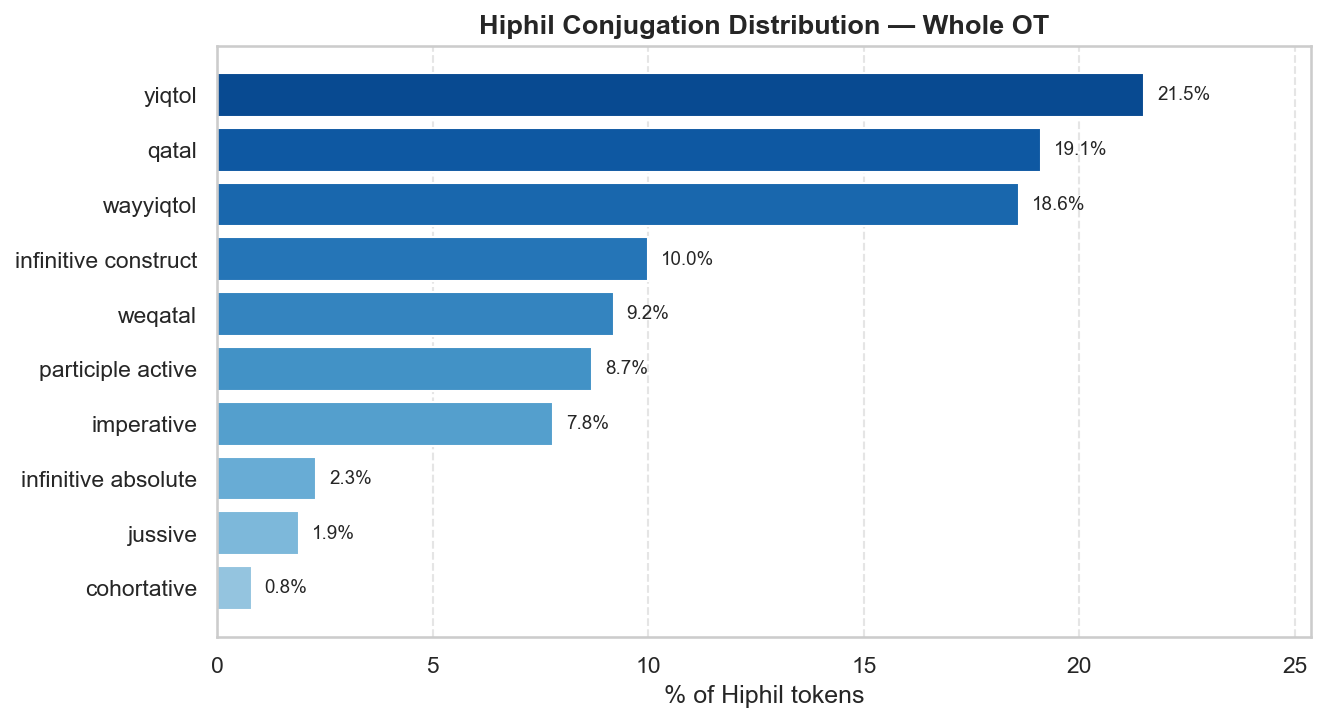
| Conjugation | Count | % |
|---|---|---|
| wayyiqtol | 1,750 | 18.6% |
| qatal | 1,797 | 19.1% |
| yiqtol | 2,020 | 21.5% |
| weqatal | 870 | 9.2% |
| imperative | 736 | 7.8% |
| jussive | 176 | 1.9% |
| cohortative | 79 | 0.8% |
| participle active | 820 | 8.7% |
| infinitive construct | 941 | 10.0% |
| infinitive absolute | 220 | 2.3% |
Teaching note: The yiqtol and wayyiqtol together account for over 40% of all Hiphil tokens, reflecting the Hiphil's heavy use in narrative action sequences. The high imperative count (7.8%) reflects the Hiphil's use in commands to bring, deliver, or act on behalf of others.
3. Distribution Across Books
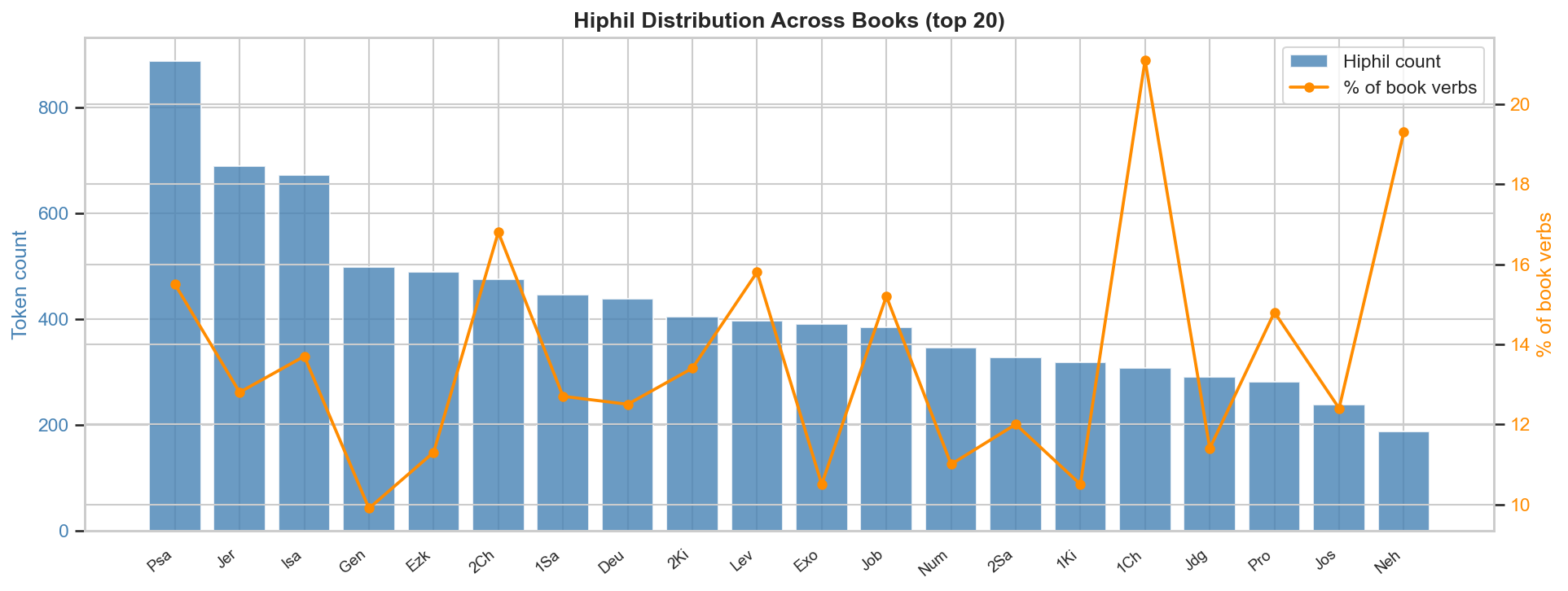
| Book | Count | % of OT Hiphil | % of book verbs |
|---|---|---|---|
| Psa | 887 | 9.4% | 15.5% |
| Jer | 689 | 7.3% | 12.8% |
| Isa | 672 | 7.1% | 13.7% |
| Gen | 498 | 5.3% | 9.9% |
| Ezk | 489 | 5.2% | 11.3% |
| 2Ch | 475 | 5.0% | 16.8% |
| 1Sa | 446 | 4.7% | 12.7% |
| Deu | 438 | 4.7% | 12.5% |
| 2Ki | 404 | 4.3% | 13.4% |
| Lev | 396 | 4.2% | 15.8% |
| Exo | 391 | 4.2% | 10.5% |
| Job | 385 | 4.1% | 15.2% |
| Num | 346 | 3.7% | 11.0% |
| 2Sa | 327 | 3.5% | 12.0% |
| 1Ki | 319 | 3.4% | 10.5% |
| 1Ch | 307 | 3.3% | 21.1% |
| Jdg | 290 | 3.1% | 11.4% |
| Pro | 282 | 3.0% | 14.8% |
| Jos | 239 | 2.5% | 12.4% |
| Neh | 188 | 2.0% | 19.3% |
4. Hiphil vs. Other Stems by Genre
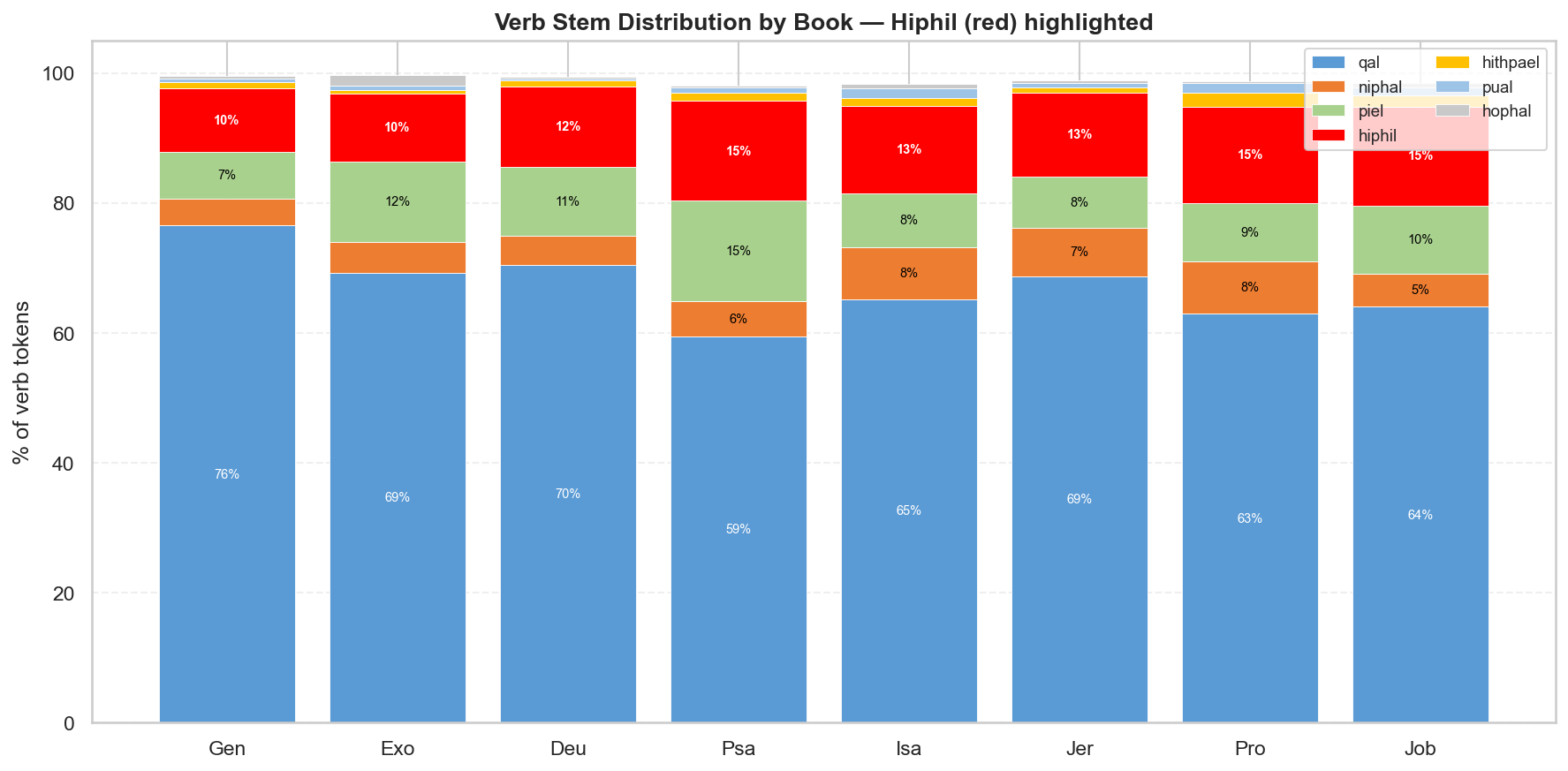
The Hiphil typically represents 9–16% of all verb tokens per book. Poetry (Psalms 15.4%, Proverbs 14.8%) and prophecy (Isaiah 13.4%, Jeremiah 12.8%) use the Hiphil proportionally more than narrative (Genesis 9.8%).
5. Most Frequent Hiphil Roots
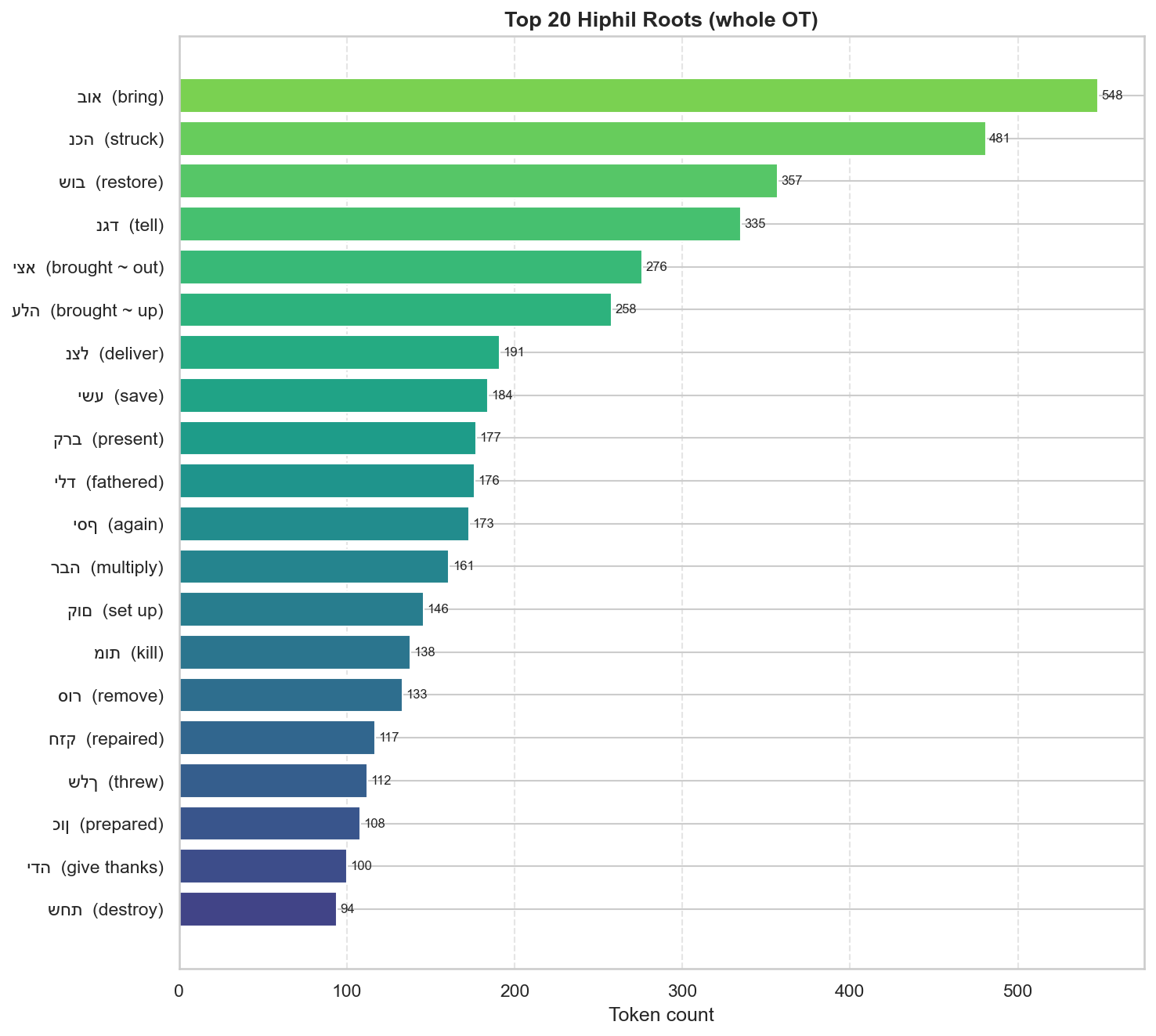
| # | Root | Lemma | Count | % | Primary meaning |
|---|---|---|---|---|---|
| 1 | בוא | בּוֹא | 548 | 12.8% | bring |
| 2 | נכה | נָכָה | 481 | 11.3% | struck |
| 3 | שוב | שׁוּב | 357 | 8.4% | restore |
| 4 | נגד | נָגַד | 335 | 7.9% | tell |
| 5 | יצא | יָצָא | 276 | 6.5% | brought ~ out |
| 6 | עלה | עָלָה | 258 | 6.0% | brought ~ up |
| 7 | נצל | נָצַל | 191 | 4.5% | deliver |
| 8 | ישע | יָשַׁע | 184 | 4.3% | save |
| 9 | קרב | קָרַב | 177 | 4.2% | present |
| 10 | ילד | יָלַד | 176 | 4.1% | fathered |
| 11 | יסף | יָסַף | 173 | 4.1% | again |
| 12 | רבה | רָבָה | 161 | 3.8% | multiply |
| 13 | קום | קוּם | 146 | 3.4% | set up |
| 14 | מות | מוּת | 138 | 3.2% | kill |
| 15 | סור | סוּר | 133 | 3.1% | remove |
| 16 | חזק | חָזַק | 117 | 2.7% | repaired |
| 17 | שלך | שָׁלַךְ | 112 | 2.6% | threw |
| 18 | כון | כּוּן | 108 | 2.5% | prepared |
| 19 | ידה | יָדָה | 100 | 2.3% | give thanks |
| 20 | שחת | שָׁחַת | 94 | 2.2% | destroy |
6. Root × Conjugation Heatmap
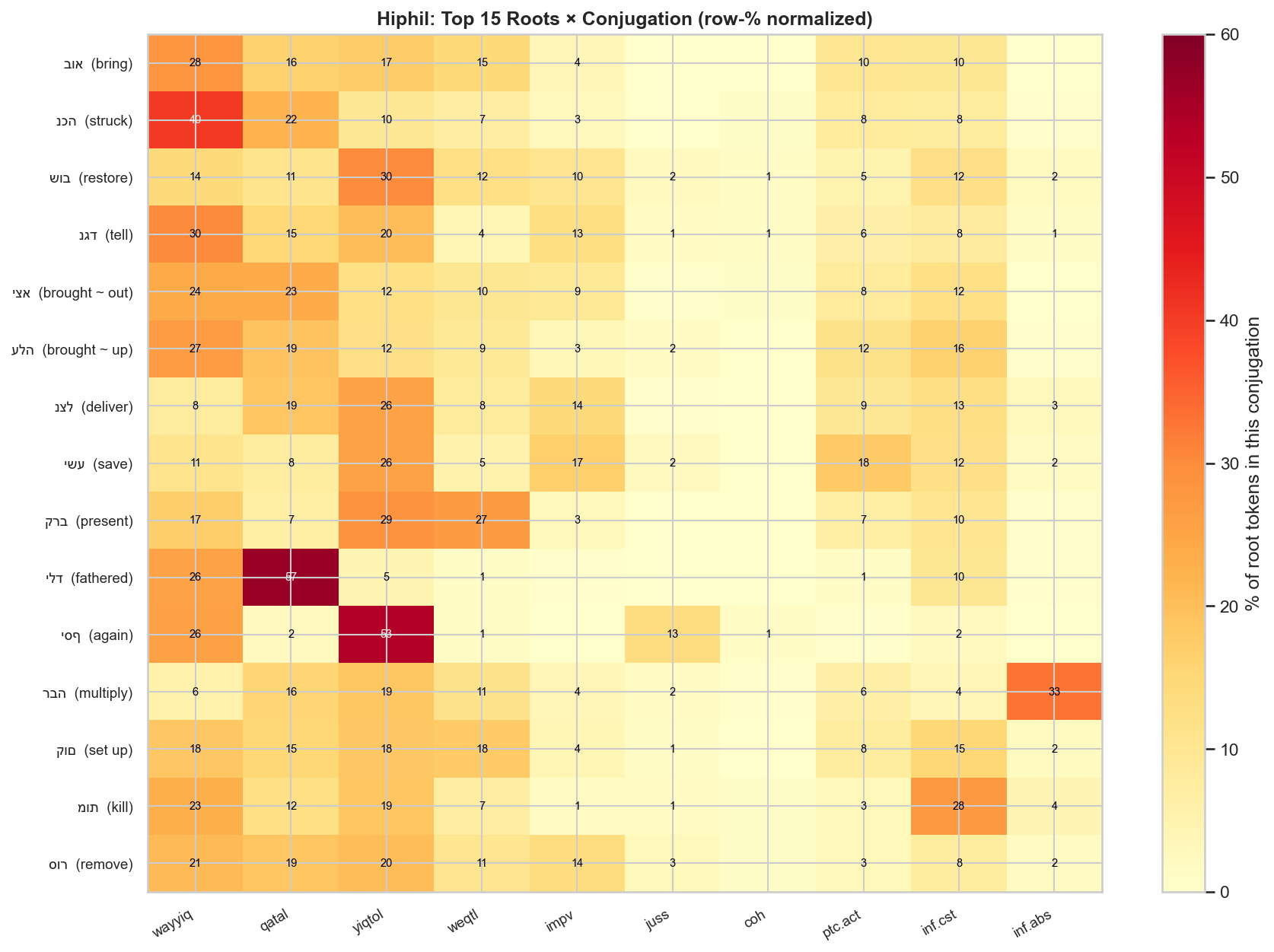
Each cell shows what percentage of that root's total Hiphil tokens appear in that conjugation. Rows are row-normalized (each root sums to 100%).
Notable patterns: - נָכָה (strike/kill): dominated by wayyiqtol — narrative combat scenes - יָסַף (add/do again): dominated by yiqtol — future/habitual "again" - רָבָה (multiply): dominated by inf.abs — emphatic constructions - נָגַד (tell/declare): strong imperative — commands to report/announce
7. Hiphil-Dominant Roots (≥80% of occurrences)
These roots almost exclusively occur in the Hiphil. They are "built-in causatives" with no separate Qal meaning.
| Root | Lemma | Hiphil | Total | % | Gloss |
|---|---|---|---|---|---|
| נכה | נָכָה | 481.0 | 500.0 | 96.2% | struck |
| נגד | נָגַד | 335.0 | 370.0 | 90.5% | tell |
| נצל | נָצַל | 191.0 | 213.0 | 89.7% | deliver |
| יסף | יָסַף | 173.0 | 209.0 | 82.8% | again |
| ישע | יָשַׁע | 157.0 | 178.0 | 88.2% | save |
| שלך | שָׁלַךְ | 112.0 | 125.0 | 89.6% | threw |
| ידה | יָדָה | 100.0 | 114.0 | 87.7% | give thanks |
| נוח | נוח | 71.0 | 72.0 | 98.6% | leave |
| נבט | נָבַט | 68.0 | 69.0 | 98.6% | look |
| שכם | שָׁכַם | 65.0 | 65.0 | 100.0% | rose early |
| שקה | שָׁקָה | 60.0 | 61.0 | 98.4% | water |
| שכל | שָׂכַל | 60.0 | 62.0 | 96.8% | understand |
| ירה | יָרָה | 59.0 | 72.0 | 81.9% | teach |
| יכח | יָכַח | 54.0 | 59.0 | 91.5% | rebuke |
| נשג | נָשַׂג | 49.0 | 49.0 | 100.0% | overtake |
| חרם | חָרַם | 48.0 | 52.0 | 92.3% | utterly destroyed |
| כעס | כָּעַס | 46.0 | 54.0 | 85.2% | provoking ~ toanger |
| קשב | קָשַׁב | 45.0 | 46.0 | 97.8% | listen |
| פרר | פָּרַר | 43.0 | 50.0 | 86.0% | break |
| אזן | אָזַן | 41.0 | 42.0 | 97.6% | listen |
8. Semantic Function Categories
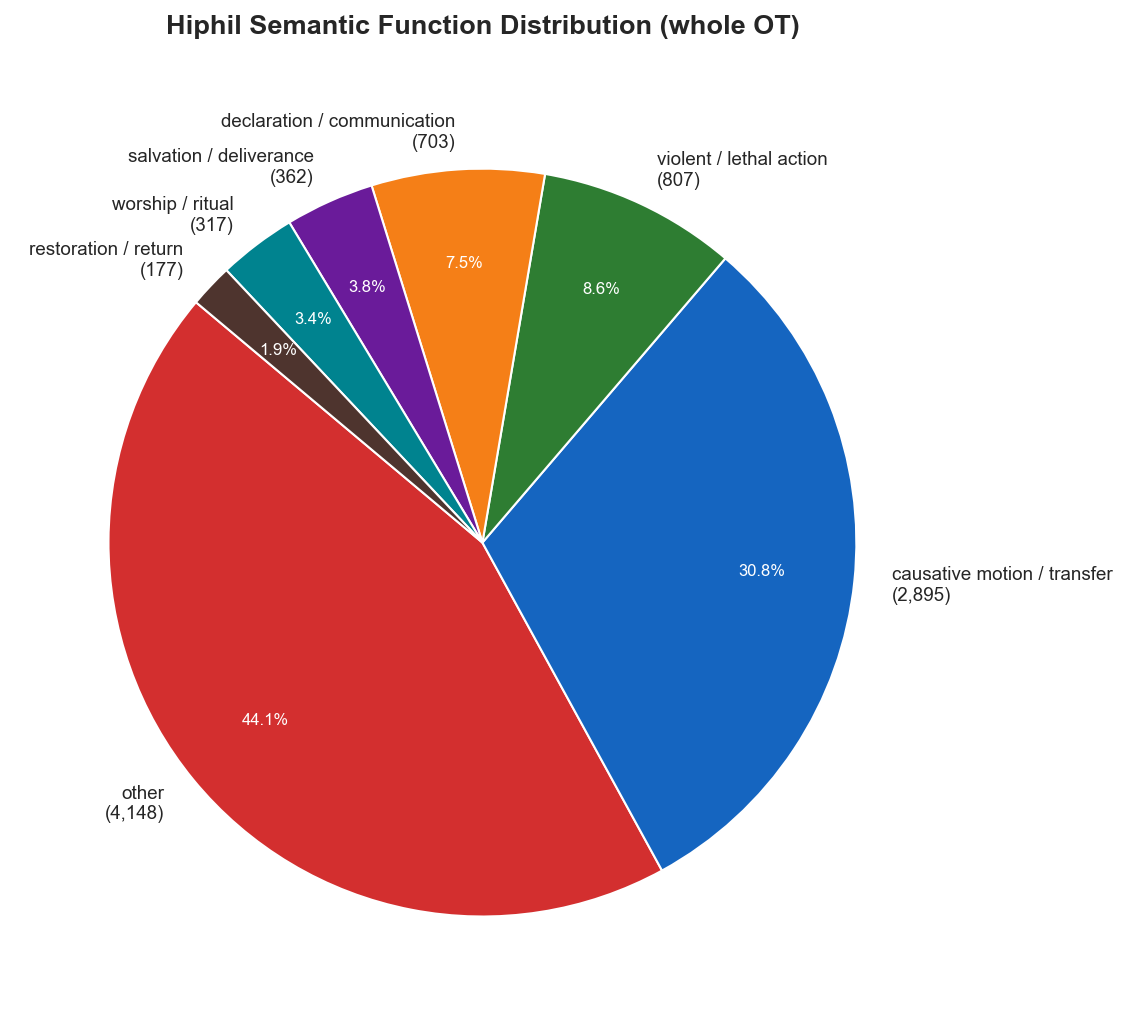
| Category | Count | % |
|---|---|---|
| other | 4,148 | 44.1% |
| causative motion / transfer | 2,895 | 30.8% |
| violent / lethal action | 807 | 8.6% |
| declaration / communication | 703 | 7.5% |
| salvation / deliverance | 362 | 3.8% |
| worship / ritual | 317 | 3.4% |
| restoration / return | 177 | 1.9% |
Teaching note: The largest category (causative motion/transfer) reflects the Hiphil's core function of "causing something to move" — bringing, leading, sending, presenting. The violence/lethal category (נָכָה "strike", מוּת "kill") is the second largest, common in historical narrative.
9. Key Morphological Markers
| Form | Prefix/suffix | Vowel pattern |
|---|---|---|
| Perfect (qatal) 3ms | הִ- | הִקְטִיל |
| Imperfect (yiqtol) 3ms | יַ- | יַקְטִיל |
| Wayyiqtol 3ms | וַיַּ- | וַיַּקְטֵל |
| Imperative ms | הַ- | הַקְטֵל |
| Inf. Construct | הַ- | הַקְטִיל |
| Inf. Absolute | הַ- | הַקְטֵל |
| Participle ms | מַ- | מַקְטִיל |
Diagnostic sign: In the Hiphil, the imperfect and participle share the prefix מַ- / יַ- with a characteristic i-vowel (חִירִיק) in the second syllable, making it distinctive from the Piel (יְקַטֵּל) and Qal (יִקְטֹל).